|
 |
 |
 |
 |
 |
 |
 |
 |

 |
Red Planet Beckons Stronger
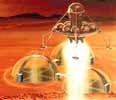
Huntsville - March 4, 1999 - Researchers at Marshall Space Flight Center have declared that a self powered Martian base is possible utilizing various local resources that would be mined and extracted to build power receivers that would collect power beamed from solar collectors in Mars orbit. Throughout NASA small groups of researchers are bringing together an increasing range of new ideas that would be fundamental to any manned missions to the Red planet that has enchanted humans for thousands of years. Known the world over by various local names, Mars is looming ever closer for human exploration and eventual colonization. After several years of intensive research using a new generation of low cost explorers in orbit and on dry land, excitement is again building as the primary mapping phase for Mars Global Surveyor begins. Throughout both the space science and technology fields scientists are rubbing their hands with glee as a new world begins to be opened up in virtually real time. Later this year to more robot explorers will arrive at Mars; the Mars Polar Lander that will attempt a landing near the Martian south polar cap, and Mars Orbitor which will pick up where Surveyor leaves off. With additional instruments for new and expanded analysis, Mars Orbitor will only increase interest in Martian resources and the desire to send humans for that personal touch that is the heart of exploration. In an excellent overview article Dr. Peter Curreri, a materials scientist at NASA's Marshall Space Flight Center provides readers with some of the key issues facing the first human explorers of Mars survive so they may thrive.
Utilization of Martian Resources
Surveyor Reports At SpaceDaily Mars 98 Reports From Spacer.Com Mission Links
Mars Coverage at Spacer.Com
Future Missions
Areography
Pathfinder
Email This Article Comment On This Article Related Links Space
 Satellite Launch To Boost DTH In India
 Calcutta, India (SPX) Dec 28, 2005
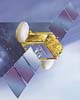
The successful launch Thursday of India's heaviest satellite from spaceport of Kourou in French Guyana may have boosted the country's space research efforts to yet another level, but it has also lifted the spirits of at least three Direct-To-Home televisions broadcasters, one of which has been waiting for years to launch its services in India. |
|
|

|
|
|
|
|
|
|
|
|
|
|
|
| The content herein, unless otherwise known to be public domain, are Copyright 1995-2006 - SpaceDaily.AFP and UPI Wire Stories are copyright Agence France-Presse and United Press International. ESA PortalReports are copyright European Space Agency. All NASA sourced material is public domain. Additionalcopyrights may apply in whole or part to other bona fide parties. Advertising does not imply endorsement,agreement or approval of any opinions, statements or information provided by SpaceDaily on any Web page published or hosted by SpaceDaily. Privacy Statement |