|
 |
 |
 |
 |
 |
 |
 |
 |

 |
Record Year For Meteorite Recovery In Canada
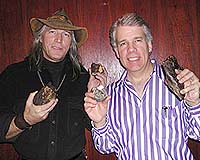
Calgary AB (SPX) Dec 20, 2005 Manitoba becomes meteorite capital, as Canada's most successful meteorite hunter proves meteorite "dumping ground" theory, east of Winnipeg. The discovery of four new meteorites in 2005 makes it a record-setting year for recovering rocks from outer space in Canada and also confirms a University of Calgary scientist's belief that an extraordinary concentration of meteorites left behind after the last Ice Age is located in southeastern Manitoba. "Scientists have been collecting meteorites in Antarctica for more than two decades where glaciers have concentrated them along the edges of the continent. Many have postulated that the continental ice sheet that covered Canada might also have done this," said U of C planetary scientist Dr. Alan Hildebrand, co-director of the Prairie Meteorite Search. "That another meteorite was found with relatively little effort pretty much establishes that an unusual concentration of meteorites does exist in eastern Manitoba, and the continental glaciers are the obvious culprit to have put them there." After becoming the first Canadian to discover two separate meteorites last summer, Winnipeg-based rock collector Derek Erstelle has now shattered the Canadian record by locating fragments of weathered iron that the Prairie Meteorite Search has shown to be another new meteorite from the bush near the Ontario border. The discovery is exciting news for Manitoba's astronomy community. "We're obviously very excited about these meteorite discoveries, and we hope that this signals even more discoveries in the future," said Scott Young, manager of the Manitoba Museum's planetarium and science gallery. "Manitoba is under-represented in the meteorite game, so this is our chance to climb the meteorite ladder." Erstelle's latest find happened in October while he was testing Hildebrand's theory that his previous two meteorites were found relatively close together in the forest because the rocks dropped there when the glaciers that covered much of North America were retreating about 12,000 years ago. The third meteorite is a collection of heavily-rusted iron fragments that were found about 40 kilometres from Erstelle's previous two discoveries north of the town of Pinawa. "I try to mimic animal behaviour when I'm hunting," Erstelle said of his effective meteorite hunting technique. "For meteorite searching I sit up high like a raptor and scan the exposed gravel banks with binoculars for unusual rusty spots. Then I check each one to see if something unusual is there." He found the newest specimen on a gravel bar of the Whiteshell River just above where it empties into Lone Island Lake in the Whiteshell Provincial Park, about 100 km east of Winnipeg. The Lone Island Lake meteorite is the 8th meteorite to be discovered in Manitoba, the 9th meteorite identified by the Prairie Meteorite Search, and the 68th new meteorite to be recovered in Canada. Erstelle was able to recover about five kilograms of material after locating the crumbling remains of the meteorite with his metal detector. "The rusty meteorite was already breaking to pieces, but was triggering my metal detector. I dug to get additional pieces and eventually screened the gravel around where the pieces were to get all that I could," he said. Hildebrand, holder of a Canada Research Chair in Planetary Sciences, said he was initially skeptical Erstelle had found another meteorite. "Derek's recent discovery is very weathered, so much so, that when I received the samples that I didn't think that they were meteorites," Hildebrand said. "But I couldn't tell what type of rock they were so I cut one, and to my surprise found metal inside. We checked it with the microprobe and the metal contained nickel confirming its origin." In July, the Prairie Meteorite Search confirmed that two fragments of a meteorite Erstelle found about 40 kilometres away near Bernic Lake in 2002 were from a separate meteorite than a similar-looking specimen he collected near Pinawa in 1998 or 1999. Hildebrand determined that the rocks were found where two lobes of the ancient Laurentide ice sheet met about 11,500 years ago, providing an explanation for their remarkably close proximity. Hildebrand said further tests will be done to determine how long the rocks have been on Earth and to see if more meteorites can be found in the area. "If these meteorites fell on the ice sheet, they would have to have been on Earth for 12,000 years or longer," Hildebrand said, noting that Erstelle's latest find is very weathered, indicating that it fell to Earth long ago. "We now have to make a plan for the Prairie Meteorite Search to further investigate the region next summer and I expect Manitoba could well become Canada's pre-eminent meteorite province during 2006." Young is also hopeful more meteorites will be found in Manitoba next year. "I encourage people to keep an eye out for unusual looking rocks, and bring them to someone who can identify them - the meteorites are out there somewhere, just waiting to be found," he said. The Prairie Meteorite Search is led by Hildebrand, Dr. Peter Brown from the University of Western Ontario and Dr. Martin Beech from Campion College at the University of Regina. They are all members of the Meteorites and Impacts Advisory Committee (MIAC) to the Canadian Space Agency. MIAC is Canada's volunteer group charged with the investigation of fireballs and the recovery of meteorites. The Canadian Space Agency funded most of the project's field costs for the summer of 2005. Community Email This Article Comment On This Article Related Links Prairie Meteorite Search University of Calgary SpaceDaily Search SpaceDaily Subscribe To SpaceDaily Express Asteroid and Comet Mission News, Science and Technology
 NASA'S Spitzer Finds Possible Comet Dust Around Dead Star
 Pasadena CA (SPX) Jan 12, 2006
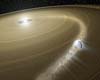
NASA's Spitzer Space Telescope has spotted what may be comet dust sprinkled around the white dwarf star G29-38, which died approximately 500 million years ago. |
|
|

| The content herein, unless otherwise known to be public domain, are Copyright 1995-2006 - SpaceDaily.AFP and UPI Wire Stories are copyright Agence France-Presse and United Press International. ESA PortalReports are copyright European Space Agency. All NASA sourced material is public domain. Additionalcopyrights may apply in whole or part to other bona fide parties. Advertising does not imply endorsement,agreement or approval of any opinions, statements or information provided by SpaceDaily on any Web page published or hosted by SpaceDaily. Privacy Statement |