|
 |
 |
 |
 |
 |
 |
 |
 |

 |
Record Breaking Luminosity Boosts Potential Of Tevatron Collider
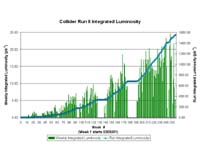
Batavia IL (SPX) Mar 09, 2006 The record-breaking performance of the Tevatron collider at the US Department of Energy's Fermi National Accelerator Laboratory is pushing the search for dark matter, supersymmetric particles and extra dimensions to new limits. Repeatedly smashing peak luminosity records, the Tevatron has created record numbers of proton-antiproton collisions that provide the means to unveil the secrets of the universe. Accelerator experts at the lab announced that in only 14 months the Tevatron collider has produced almost five times the data sample collected during four years of Collider Run I (1992-1996), which led to the discovery of the top quark at Fermilab. Since restarting the Tevatron collider after a scheduled shutdown in December 2004, the collider has produced an integrated luminosity of 872 inverse picobarns-a measure for the number of collisions achieved. Two collider experiments, CDF and DZero, will present new results based on these datasets in the upcoming months. "High luminosity is the name of the game for particle accelerators," said DZero co-spokesperson Terry Wyatt, University of Manchester. "We are in a great position to make some exciting discoveries with the data we have. With the prospect of doubling the dataset in 2006 and again in 2007, and with 8,000 inverse picobarns expected by the end of Collider Run II, there is huge future potential." Following extensive upgrades, the high-energy Tevatron collider racked up a series of records in 2005 (see footnote), doubling the average peak luminosity-or beam brightness-and raising the world record for peak luminosity at a hadron collider to 17x1031 inverse centimeter square per second. A scheduled shutdown, from the end of February to the middle of June, 2006, is expected to boost the Tevatron performance even further. Particle physics at colliders is strikingly similar to shooting pool (a.k.a. pocket billiards): the greater the number of collisions created, the greater the likelihood of success. But while one billiard ball classically colliding with another billiard ball always adds up to two billiard balls, the near-light-speed quantum environment of E=mc2 changes the picture completely for particle collisions. "Imagine a car crash," said Steve Holmes, Associate Director for Accelerators at Fermilab. "Two 2,500-pound Minis run into each other and, instead of a fender rattling to the pavement, a 6,500-pound Hummer pops out. The more collisions we produce, the better the chance we have of finding something rare." The Tevatron uses superconducting magnets to steer protons and antiprotons around a 4-mile ring, creating collisions at the world record energy of close to 2 trillion electron volts (TeV). The challenge in creating the largest possible number of collisions is to produce as many antiprotons as possible and to squeeze them across the smallest achievable area over the longest possible span of time. Tevatron luminosity depends on having roughly equal numbers of protons and antiprotons in the colliding beams. Producing protons is easy, by particle physics standards: remove the electrons from hydrogen molecules, and you have single protons. Producing antiprotons is not easy, by any standard: colliding beams of protons with a fixed target made of nickel, with every million collisions producing about 18 antiprotons. Ultimately, Tevatron luminosity depends on the number of antiprotons available for collisions. "In the past 14 months, the peak production rate for antiprotons has increased substantially, from 150 billion antiprotons per hour to 200 billion," said Roger Dixon, head of the Fermilab Accelerator Division. "We fully integrated the Recycler antiproton storage ring into our accelerator operations, and we greatly increased the antiproton beam density by implementing electron cooling." Fermilab spent four years and $260 million to upgrade its accelerators and detectors, from 1996 to 2000. When the lab started Tevatron Collider Run II in March 2001, the progress on luminosity was sluggish. To improve the performance, accelerator experts focused on increasing the antiproton production rate; providing a third stage of antiproton cooling (concentrating the beam using the new Recycler storage ring); and increasing the transfer efficiency of antiprotons to the Tevatron. The result of these steps: more collisions than ever before, and the best prospects for scientific discoveries. There is no time like the present for Fermilab to make big news with its luminosity improvements. The Large Hadron Collider (LHC) at the European laboratory CERN will be turning on in 2007, with collisions at an energy seven times higher than the Tevatron can produce. Boosting the Tevatron luminosity enhances Fermilab's chances for discoveries before the LHC creates a significant number of collisions. "We know that the LHC will assume the high-energy frontier once it is operational, but we also know that discoveries are the best way to position ourselves at the forefront of the field and help us to secure future projects," says Fermilab Director Pier Oddone. "The Fermilab luminosity upgrades will take us there." Community Email This Article Comment On This Article Related Links US Department of Energy's Fermi National Accelerator Laboratory Stellar Chemistry, The Universe And All Within It
 Tricorder Could ID Alien Gems and Minerals
 Pittsburgh PA (SPX) Mar 12, 2006
A geoscientist is developing an instrument using a sensing technique called Raman spectroscopy, which he said could help spacecraft or robotic surface rovers identify thousands of types of minerals on other planets. |
|
|

| The content herein, unless otherwise known to be public domain, are Copyright 1995-2006 - SpaceDaily.AFP and UPI Wire Stories are copyright Agence France-Presse and United Press International. ESA PortalReports are copyright European Space Agency. All NASA sourced material is public domain. Additionalcopyrights may apply in whole or part to other bona fide parties. Advertising does not imply endorsement,agreement or approval of any opinions, statements or information provided by SpaceDaily on any Web page published or hosted by SpaceDaily. Privacy Statement |