The Senate's addition of $13.1 billion to the 2007 defense budget will be enough for the Army and Marine Corps to fix broken equipment now sitting idle. Chairman of the Joint Chiefs of Staff Gen. Peter Pace said the welcome infusion of cash will allow maintenance depots to hire back the skilled labor needed to restore and repair the backlog of vehicles and weapon systems run down by three years of war in Iraq.
However, it's only a drop in the bucket: the Army alone needs $17.1 billion to reset its force in 2007 and anticipates an annual yearly bill of $12 billion to $13 billion until two or three years after the Iraq war ends to reconstitute its equipment back to fighting form.
Pace and Defense Secretary Donald Rumsfeld assert that the military is not having a "readiness crisis," despite the fact that there are no Army brigades trained and equipped and ready now in the event of a pop-up conflict, and two-thirds of the Army -- that is, the portion not deployed, reports readiness problems. Readiness ratings tabulate how many personnel are in a unit and how much of their equipment is combat ready.
"It's not wrong to say we have equipment deficiencies," Pace told the Senate Armed Services Committee Thursday.
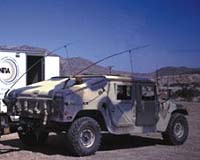
But comparatively, the Army and Marine Corps are better equipped now than they were five years ago. Then, the Army had all 2,000 uparmored Humvees required, so had a high readiness rating, Pace said. It now has 6,000 Humvees - three times as many -- but only 50 percent of the 12,000 now required.
One branch of the military that can't absorb readiness problems is the National Guard. Even fewer than a third of its brigades are fully equipped and ready, a top official said this week, and they are not only responsible for combat deployments but also for domestic duty, like responding to natural disasters and potential weapons of mass destruction terrorist attacks. The active-duty military has the luxury of downtime, but the Guard bureau does not. The Air and Army National Guards need $23 billion to restore their equipment, which they have been promised over the next five years.
Replacing lost and worn out equipment is an inherently slow process, according to Pace. It can take three years for a crashed helicopter to finally be replaced one-for-one in the inventory, by the time the aircraft is listed as lost, the contract awarded and the chopper built and delivered.
Rumsfeld told the Senate committee he sees three possible routes to solving the readiness problem. The first is for Congress to act more quickly to approve defense budgets and supplemental requests, to allow the services to keep maintenance depots manned and running.
The second option is for the Defense Department to cut in half the amount of time it takes to announce and award contracts.
The third option is for Congress to approve a revolving "reset" fund, in which funding to restore equipment lost in the war resides not connected to any spending year and without expiration.
Congress is unlikely to approve such an arrangement as it diminishes the oversight it has over Pentagon funding, and many on Capitol Hill remember the abuse of "M" accounts during the free-spending 1980s. Surpluses in defense spending under then-Defense Secretary Caspar Weinberger -- between $290 billion and $40 billion, according to the General Accounting Office -- were rolled over into unpoliced accounts for spending at the Pentagon's discretion.
Congress also rejected a Pentagon request in 2002 for a $10 billion unrestricted "war account."
As Congress heads into election season, Democrats are eager to score points against Republicans and the White House on the issue of military readiness, and they want to do so by plowing ground then-Candidate George W. Bush richly furrowed in the 2000 presidential campaign.
Bush told the Republican National Convention in 2000: "If called on by the commander-in-chief today, two entire divisions of the Army would have to report ... 'Not ready for duty, sir,'" he said.
"How many divisions will we have to report that way to that
question today based on the reporting system, General Pace?" said Rhode Island Democrat Sen. Jack Reed.
Pace confired that two-thirds of the brigades in the Army would now report as not ready.
"Sir, all I'm saying is that we are providing for our soldiers and Marines on the ground the finest equipment ever fielded. We are using it up at rates faster than we budgeted for. And therefore, to use the readiness system to identify, as you have, the requirement for more funding is absolutely correct," Pace said.
The Pentagon's defense in 2000, as it is now, was that units that are deployed always return less ready by equipment, training and rest standards. But they also return more experienced and hardened for the fight. In this case, however, there is no end in sight yet for the forces to regroup before the next crisis.
Source: United Press International