|
 |
 |
 |
 |
 |
 |
 |
 |

 |
Raytheon Presents U.S. Navy First Production JSOW-C
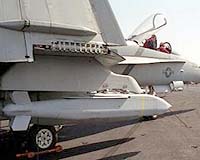
Tucson AZ (SPX) Nov 17, 2004 Raytheon Tuesday officially presented U.S. Navy officials with the unitary/penetration variant of the Joint Standoff Weapon (JSOW-C), the newest version of the successful unpowered air-to-ground weapon system. The first production delivery ceremony took place at Raytheon Missile Systems in Tucson. "JSOW-C is a significant addition to the warfighting capability of the Navy and Marine Corps," said Capt. David Dunaway, the Navy's JSOW program manager. "Putting this weapon in the hands of the warfighter culminates the long, hard work of the Navy/Raytheon, BAE Systems and Thales Missile Electronics team." "We are proud to be providing the Navy with this very affordable weapon. The JSOW-C's unitary/penetrator variant offers greatly increased capabilities, particularly against concealed and deceptive targets," said Ron Shields, Raytheon's JSOW program director. JSOW-C incorporates a Raytheon-developed uncooled, long-wave infrared seeker with automatic target acquisition algorithms, providing the Navy a launch-and-leave weapon with a long-range standoff precision strike capability. JSOW-C is the first U.S. weapon to incorporate the two stage broach blast fragmentation/ penetration warhead, developed by the United Kingdom's BAE Systems. Thales provides the fuze. JSOW-C has a unique capability for a glide weapon in its ability to attack a hardened target in a near-horizontal mode. JSOW is a joint Navy and Air Force program. It is a family of low-cost, highly survivable air-to-ground weapons employing an integrated Global Positioning System/Inertial Navigation system that guides the weapon to the target. More than 400 JSOW-As have been used in combat operations to date. The JSOW family uses a common and modular weapon body capable of carrying a variety of payloads and handling multiple munitions. Its long standoff range demonstrated at 63 nautical miles allows delivery from well outside the lethal range of most enemy air defenses. The AGM-154A (also called JSOW-A) variant dispenses BLU-97 combined-effect bomblets for use against soft and area targets. It is produced for use on the F/A-18, F-16, F-15E, B-1, B-2 and B-52 aircraft. The AGM-154C (JSOW-C) is currently being produced for Navy F/A-18s and has been selected by Poland for use on its F-16s. The Navy/Raytheon team is developing a Block II configuration of the JSOW weapon system that provides significant cost reductions to all JSOW versions. The first Block II configuration weapons will be delivered in 2007. Additionally, other JSOW improvements are under way to add anti-ship capability, reduce unexploded ordnance concerns, hit moving targets, provide bomb hit indication, provide network capability and further reduce costs. Community Email This Article Comment On This Article Related Links Raytheon SpaceDaily Search SpaceDaily Subscribe To SpaceDaily Express Learn about missile defense at SpaceWar.com All about missiles at SpaceWar.com
 Northrop Grumman Wins Contract For Target And Space-Launch Missile Work
 Reston VA (SPX) Jan 12, 2006
Northrop Grumman has been awarded a follow-on contract to provide technical support to the U.S. Air Force's Rocket Systems Launch Program (RSLP). |
|
|

| The content herein, unless otherwise known to be public domain, are Copyright 1995-2006 - SpaceDaily.AFP and UPI Wire Stories are copyright Agence France-Presse and United Press International. ESA PortalReports are copyright European Space Agency. All NASA sourced material is public domain. Additionalcopyrights may apply in whole or part to other bona fide parties. Advertising does not imply endorsement,agreement or approval of any opinions, statements or information provided by SpaceDaily on any Web page published or hosted by SpaceDaily. Privacy Statement |