|
 |
 |
 |
 |
 |
 |
 |
 |

 |
Raytheon Completes Negotiations Billion Dollar Contract For JLENS Development
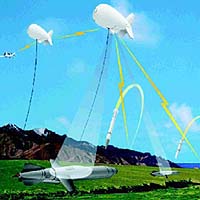
Tewksbury MA (SPX) Jan 04, 2007 Raytheon recently completed negotiations with the U.S. Army resulting in finalizing a contract modification for system development and demonstration of the Joint Land Attack Cruise Missile Defense Elevated Netted Sensor System (JLENS). Raytheon Integrated Defense Systems' (IDS) JLENS provides a long-duration, wide-area cruise missile defense capability while also providing elevated communications capabilities. JLENS also supports situational awareness for the battlefield commander. The system provides over-the-horizon detection and tracking of incoming cruise missiles with sufficient warning to enable air defense systems to engage and defeat the threat. Each JLENS consists of a long-range surveillance radar and a high-performance fire control radar, each integrated onto a large aerostat connected via tether to a ground-based processing station. System testing is scheduled to begin in 2010 with program completion in 2012. "Raytheon looks forward to working closely with the Army as we bring this essential cruise missile defense capability to our warfighters," said Rick Yuse, vice president of IDS Integrated Air Defense. "JLENS is critical to the Army's system of systems approach to cruise missile defense, utilizing a network of sensors in support of a wide variety of weapons to provide over- the-horizon threat detection and engagement." JLENS is managed by U.S. Army Product Manager Lt. Col. Jeffrey K. Souder as part of the Cruise Missile Defense Systems Project Office at Redstone Arsenal, Ala. "This award marks the end of months of detailed work to define just how the JLENS government/industry team will design, build, test, train, and field the system," said Souder. "I really appreciate their spirit of collaboration and hard work. The team always had the warfighter's needs in mind, and if past performance is any indication of the future -- and in this case I think it is -- this team is going to deliver an incredibly capable defensive system to that warfighter on time and within budget. We need JLENS, and this team is going to make the program a success." "In addition to providing a significant cruise missile defense capability, the JLENS system will also be capable of tracking surface moving targets and tactical ballistic missiles during their boost phase, and passing target data to various weapon systems and platforms across the military services," said Ralph Acaba, Raytheon IDS program director for JLENS. "The ability to perform multiple missions for extended periods of time and interoperate with other systems such as the Army PATRIOT and the Navy Standard Missile makes JLENS a true enabler of Joint Battlespace Integration. This system is going to make a big difference on the battlefield of the future." Work on the program will be performed at Raytheon sites in Massachusetts, California, Texas and Maryland. Raytheon IDS will develop the fire control radar and processing station. TCOM, L.P., based in Maryland, will develop the aerostat and associated ground equipment. Community Email This Article Comment On This Article Related Links Raytheon Learn about missile defense at SpaceWar.com Learn about missile defense at SpaceWar.com Learn about nuclear weapons doctrine and defense at SpaceWar.com All about missiles at SpaceWar.com Learn about the Superpowers of the 21st Century at SpaceWar.com
 Israel Could Abandon Own Missiles For US System
 Jerusalem (AFP) Jan 02, 2007
Israel is considering halting the development of a new generation of its Arrow defense missiles due to the high costs involved in favour of US-made missiles, the Haaretz newspaper reported Tuesday. Following negotiations in recent months, Israeli leaders will make a final decision on whether to phase out the Arrow, or Hetz, missiles and opt instead for the US-made THAAD missile defense system in the coming year, it said. |
|
|

| The content herein, unless otherwise known to be public domain, are Copyright 1995-2006 - SpaceDaily.AFP and UPI Wire Stories are copyright Agence France-Presse and United Press International. ESA PortalReports are copyright European Space Agency. All NASA sourced material is public domain. Additionalcopyrights may apply in whole or part to other bona fide parties. Advertising does not imply endorsement,agreement or approval of any opinions, statements or information provided by SpaceDaily on any Web page published or hosted by SpaceDaily. Privacy Statement |