
 |
 |
 |
 |
 |
 |
 |
 |
 |

 |
Raytheon Completes Captive Carry Test Of JSOW-ER
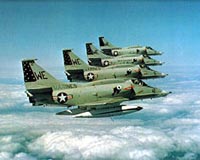
Tucson AZ (SPX) Jul 18, 2008 Raytheon has completed captive carry testing of the Joint Standoff Weapon Extended Range. The test proved Raytheon will be able to deliver on a recently awarded $4.1 million U.S. Navy contract to conduct a free-flight demonstration of the JSOW-ER in 2009. JSOW-ER will provide the warfighter a weapon with a range of 300 nautical miles (345 statute miles) for approximately $350,000 in 2007 dollars. During the Raytheon-funded test, a JSOW-ER was loaded onto an A-4 Skyhawk fighter aircraft, and the weapon's engine was ignited at 25,000 feet. The aircraft then flew the same mission profiles the missile might experience during a combat mission. The test subjected the weapon to many of the same stressors -- wind, vibration and extreme temperatures -- the JSOW-ER would face during an operational mission. "This test proved our flush-inlet design provides the JSOW-ER's engine with enough air to ignite and operate under extreme conditions," said Harry Schulte, vice president of Raytheon Missile Systems' Air Warfare Systems' product line. "With this test under our belt, I am confident we will be able to meet our contractual obligations to the Navy and conduct a free flight demonstration in spring 2009." The captive carry test came on the heels of a series of Raytheon-funded functional ground tests of the JSOW-ER engine in April. The tests verified that newly developed software could adequately control the flow of fuel to the engine's weapon. The test also ensured the fuel system was properly integrated into the weapon. The JSOW-ER is a powered variant of the combat-proven glide JSOW. It takes the proven GPS/Inertial Navigation System reliability of earlier JSOW models and combines it with the network-enabled, maritime-interdiction capabilities currently under development for the JSOW C-1. By adding a 150-pound thrust class engine without violating JSOW's outer mold lines or mass properties, the JSOW-ER gains a range of approximately 300 nautical miles. As a result, JSOW-ER integration cost is minimal on any aircraft on which glide JSOW is currently integrated. JSOW-ER's affordability and longer range can, in large part, be attributed to the weapon's 150-pound thrust class Hamilton Sundstrand engine. The engine is the same one used in Raytheon's Miniature Air Launched Decoy. It will help keep the JSOW-ER affordable while reducing the MALD(TM) cost per unit, thanks to economies of scale. JSOW-ER will also incorporate the same initiatives that reduced the unit cost of JSOW Block II by more than 25 percent. JSOW is a joint U.S. Navy and U.S. Air Force program. JSOW is a family of low-cost, air-to-ground weapons that employs an integrated GPS/INS that guides the weapon to the target. The JSOW uses a common and modular weapon body capable of carrying various payloads. Its long standoff range allows delivery from well outside the lethal range of most enemy air defenses. Community Email This Article Comment On This Article Share This Article With Planet Earth
Related Links Raytheon Learn about missile defense at SpaceWar.com All about missiles at SpaceWar.com
 Iran Says Shahab-3 Missile Has Longer Than Reported Range
 Tehran, Iran (RIA Novosti) Jul 16, 2008
Iran's Shahab-3 missiles have a range greater than the reported 2,000 km (1,240 miles), Iran's Fars news agency said on Monday, quoting the country's deputy defense minister. |
|
|

| The content herein, unless otherwise known to be public domain, are Copyright 1995-2007 - SpaceDaily.AFP and UPI Wire Stories are copyright Agence France-Presse and United Press International. ESA Portal Reports are copyright European Space Agency. All NASA sourced material is public domain. Additional copyrights may apply in whole or part to other bona fide parties. Advertising does not imply endorsement,agreement or approval of any opinions, statements or information provided by SpaceDaily on any Web page published or hosted by SpaceDaily. Privacy Statement |
 del.icio.us
 Digg
Digg Reddit
 YahooMyWeb
 Google
 Facebook