|
 |
 |
 |
 |
 |
 |
 |
 |

 |
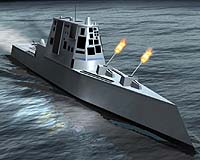
Raytheon Advances Zumwalt's Integrated Undersea Warfare System To Production
Tewksbury MA (SPX) Aug 24, 2007 Raytheon achieved a significant milestone in the Zumwalt Class destroyer program with the successful design review of the ship's undersea warfare systems -- collectively referred to as the integrated acoustic sensor suite. With this success, the U.S. Navy has given Raytheon Integrated Defense Systems (IDS) approval to advance the acoustic sensor suite's design into production. The acoustic sensor suite delivers critical capabilities by providing operators with a complete undersea warfare picture that includes the search for, and detection of, potential threats such as submarines, torpedoes, mines and unmanned undersea vehicles. The suite integrates all Zumwalt acoustic undersea warfare systems and subsystems, including the dual frequency bow array, towed array, towed torpedo countermeasures, expendable bathythermograph, data sensor, acoustic decoy launcher, underwater communications, and associated software. "The successful review proved to the Navy customer that this open architecture, integrated sonar system will effectively meet the design requirements of the Zumwalt Class destroyers," said Barbara Belt, IDS' program manager for the acoustic sensor suite. "The modularity of the suite's design offers the potential for widespread use on other naval platforms." The acoustic sensor suite's open architecture conforms to the Navy's enterprise peer review process business model and technology insertion strategy. The solution for Zumwalt supports the Navy's goal of a single, common configuration for undersea warfare processing for its family of ships, thereby reducing lifecycle costs while allowing for rapid warfighting improvements. With the solution on board Zumwalt, the Navy will achieve a 33 percent reduction in undersea warfare manning requirements as compared to current ships in the fleet. The design review -- which also determined that predefined space and weight allocations on board a Zumwalt Class ship are adequate to house the components of the acoustic sensor suite -- took place at the Raytheon IDS Maritime Mission Center, Portsmouth, R.I. Participants included representatives from Raytheon, Naval Sea Systems Command, the Naval Undersea Warfare Center and the Naval Surface Warfare Center, as well as Lockheed Martin and other subcontractors. The Zumwalt Class destroyer program is one of several programs to successfully employ IDS' OpenAIR (Affordability, Innovation and Results) business model that leverages the best of academia, large businesses, and small businesses including Argon ST, Applied Acoustic Concepts, and Adaptive Methods. OpenAIR provides customers with effective solutions at affordable prices, ensures repeated collaboration, and combines IDS' knowledge and processes with the innovation and agility of small business. Raytheon IDS serves as the prime mission systems integrator for all electronic and combat systems for the Zumwalt Class destroyer program under the Navy's DDG 1000 Detail Design and Integration contract awarded in 2005. Working together with the Navy and a team of industry leaders, IDS is leading the effort to transform the Navy's ship requirements to reality. Integrated Defense Systems is Raytheon's leader in Joint Battlespace Integration providing affordable, integrated solutions to a broad international and domestic customer base, including the U.S. Missile Defense Agency, the U.S. Armed Forces and the Department of Homeland Security. Community Email This Article Comment On This Article Related Links Raytheon IDS Naval Warfare in the 21st Century
 US Navy Recommends Raytheon Submarine Combat System For Fleet Introduction
 Tewksbury MA (SPX) Aug 22, 2007
The U.S. Navy has recommended Raytheon's advanced submarine combat control system, AN/BYG-1, for fleet introduction on the SSGN Ohio Class and SSN-21 Seawolf Class attack submarines after favorable tests and evaluations. The recent Follow-on Operational Test and Evaluation reports highlighted several performance enhancements and confirmed the operational effectiveness and suitability of the AN/BYG-1(V)6 and (V)7 for the SSN-21 and SSGN platforms. |
|
|

| The content herein, unless otherwise known to be public domain, are Copyright 1995-2007 - SpaceDaily.AFP and UPI Wire Stories are copyright Agence France-Presse and United Press International. ESA Portal Reports are copyright European Space Agency. All NASA sourced material is public domain. Additional copyrights may apply in whole or part to other bona fide parties. Advertising does not imply endorsement,agreement or approval of any opinions, statements or information provided by SpaceDaily on any Web page published or hosted by SpaceDaily. Privacy Statement |