|
 |
 |
 |
 |
 |
 |
 |
 |

 |
RaySat Introduces Antenna For In-Motion High Speed Digital Access
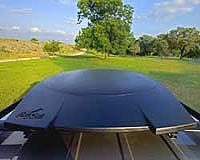
Las Vegas NV (SPX) Jan 14, 2005 Announcing a breakthrough in mobile computing and communications, RaySat, a developer of mobile video receiving systems, today introduced the world's first vehicle-based satellite antenna providing in-motion, high-speed Internet access to motorists, including emergency personnel, riding in cars, trucks, or motor homes. The new SpeedRay 3000 is based on an enclosed low-profile, roof-mounted antenna, which turns any vehicle into a rolling "hot spot," enabling Internet access to laptops, PDAs, or other devices equipped with Wi-Fi wireless networking technology. The innovative system provides Internet download speeds up to 2 mbps and upload speeds up to 128 kbps, shared among users in the vehicle. In addition, using technology also developed by RaySat, the SpeedRay 3000 provides moving vehicles with strong reception of digital satellite TV and music channels. Since it communicates solely via satellite, the antenna can be used effectively in remote areas where cellular and land-line connections are not available. "With our latest breakthrough technology, we're moving from being purely an in-vehicle entertainment company to being a communications solution provider in moving vehicles," said RaySat President and CEO Samer Salameh. "We came out of the gate swinging late last year with an array of products that are completely revolutionizing the industry. Partner and customer response has been great, due to our combination of great performance and leading technology." The SpeedRay 3000 is compact, easy to install and employs a five-inch high dish antenna housed in a low-profile, roof-mounted, impact-resistant case. Designed for use by consumers as well as emergency "first responders," the new antenna provides a highly reliable alternative to terrestrial based communications systems, which may fail in emergencies or not provide sufficient range in remote areas. To provide continuous signal feeds, the SpeedRay 3000 uses a phased-array antenna that rotates (inside its housing). Its panels constantly move up and down and back and forth, to track and maintain the satellite signal regardless of the vehicle's position relative to the satellite with which it is in communication. For convenience and reliability, the system's Wi-Fi transceiver, which supports the most widely used wireless networking standards (IEEE 802.11b and 802.11g), is built into the dish antenna housing and so requires no separate installation or connections. Salameh said the RaySat is scheduled for availability in the third quarter of 2005 and will retail for $3,495.00. Installation and subscriptions to TV and Internet service are additional. Community Email This Article Comment On This Article Related Links RaySat SpaceDaily Search SpaceDaily Subscribe To SpaceDaily Express Space Technology News - Applications and Research
 Industry Team Achieve New Communications Technology With AESA Radars
 Baltimore MD (SPX) Jan 12, 2006
A team comprised of three leading US aerospace and defense contractors has demonstrated an innovative technological use of active electronically scanned array (AESA) radars for high-bandwidth communications. |
|
|

| The content herein, unless otherwise known to be public domain, are Copyright 1995-2006 - SpaceDaily.AFP and UPI Wire Stories are copyright Agence France-Presse and United Press International. ESA PortalReports are copyright European Space Agency. All NASA sourced material is public domain. Additionalcopyrights may apply in whole or part to other bona fide parties. Advertising does not imply endorsement,agreement or approval of any opinions, statements or information provided by SpaceDaily on any Web page published or hosted by SpaceDaily. Privacy Statement |