|
 |
 |
 |
 |
 |
 |
 |
 |

 |
Rapid-Fire Jaws Propel Ants To Safety
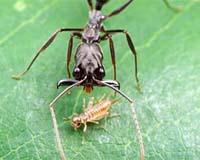
Champaign IL (SPX) Aug 22, 2006 Move aside, mantis shrimp; trap-jaw ants now hold the world record for fastest moving body parts. Scientists using a high-speed imaging system have found that the jaws in trap-jaw ants snap shut in less than a millisecond, averaging a speed of 38 meters per second (approximately 137 kilometers/hour). "Not only are these mandibles phenomenally fast, they also generate enough force to eject enemies and propel the ants through the air," said Andrew V. Suarez, a professor of entomology and of animal biology at the University of Illinois at Urbana-Champaign, and co-author of a paper that will be posted online this week ahead of regular publication by the Proceedings of the National Academy of Sciences. Trap-jaw ants (Odontomachus bauri) are found throughout Central and South America. The ants in this study were collected in Costa Rica. Typical prey includes termites and other ant species; predators include spiders, frogs and lizards. "There is nothing obvious about the ants' prey that points toward the need for an extremely fast capture mechanism," said Suarez, who is also an affiliate of the Institute for Genomic Biology at the U. of I. "Increasing speed generates more force, however, which can inflict more damage to predators or propel the ants to safety." Powered by a large head filled with muscle, the mandibles function like spring-loaded lever arms. An internal damping mechanism prevents the jaws from crushing each other. Depending upon how the ants used their jaws, they produced power for predation or for two types of defensive propulsion, the researchers report. The first type, termed bouncer defense, involved ants striking a large intruding object, simultaneously attacking the intruder while bouncing away, up to 40 centimeters in some cases, and sometimes causing the intruder to bounce away as well. The second type of defensive propulsion was the escape jump. When a threat was too large, the ant would snap its jaws off the ground, launching itself up to 8 centimeters in the air. Though not as high vertically, the horizontal ranges of the bouncer defense jumps averaged seven times greater than escape jumps. "These propulsive behaviors may be especially important given that O. bauri builds nests in leaf litter, rather than below ground," the researchers write. "Without the subterranean strongholds typical of many ants, temporary escape from predators and ejection of intruders may be essential for this species." To study the ants' movements, the researchers used a high-speed imaging system capable of taking up to 250,000 frames per second. Because the mandibles close so quickly, a complete analysis of jaw movement had not been performed before. Community Email This Article Comment On This Article Related Links University of Illinois at Urbana-Champaign Darwin Today At TerraDaily.com Darwin Today At TerraDaily.com
 Calendrical Bacteria
 Los Angeles CA (SPX) Aug 23, 2006
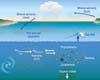
Every creature has its place and role in the oceans - even the smallest microbe, according to a new study. Scientists have long endorsed the concept of a unique biological niche for most animals and plants - a shark, for example, has a different role than a dolphin. |
|
|

| The content herein, unless otherwise known to be public domain, are Copyright 1995-2006 - SpaceDaily.AFP and UPI Wire Stories are copyright Agence France-Presse and United Press International. ESA PortalReports are copyright European Space Agency. All NASA sourced material is public domain. Additionalcopyrights may apply in whole or part to other bona fide parties. Advertising does not imply endorsement,agreement or approval of any opinions, statements or information provided by SpaceDaily on any Web page published or hosted by SpaceDaily. Privacy Statement |