|
 |
 |
 |
 |
 |
 |
 |
 |

 |
Radio Astronomy Gets Connected
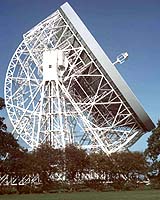
London (SPX) May 26, 2004 Work has started on the construction of an optical fibre network which will connect five radio telescopes to the giant 76-m Lovell Telescope at Jodrell Bank Observatory, operated by The University of Manchester in rural Cheshire, allowing it to operate with vastly improved sensitivity. This e-MERLIN network will operate as single radio telescope spanning 217 km, with unprecedented sensitivity provided by the enormous data rates carried by the optical fibres. The combination of high resolution due to the large separations and high sensitivity will make e-MERLIN a world-leading astronomical facility, continuing the pioneering spirit established by Sir Bernard Lovell over 50 years ago, and maintaining Jodrell Bank at the forefront of astronomical research well into the 21st century. The network will use trunk fibres largely provided by Global Crossing UK with new fibre links from each telescope to the trunks being constructed by Fujitsu Telecommunications Europe. The total data rate carried by the network will be a continuous and sustained 150 Gb/s - about five times the total UK public internet traffic. Finding a way to provide a data network of this capacity on a national scale, reaching out to rural telescope sites, within the very limited project budget has been the largest challenge facing the e-MERLIN project. Astronomers and engineers at Jodrell Bank are delighted to have found a technical and commercial solution which meets their needs. Dr Simon Garrington, project manager for e-MERLIN explained: "In an array like MERLIN, the network which transports the data is performing the same function as the curved dish of a single large radio telescope, bringing the radio waves to a common focus. "With our present links, we are only able to transport less than half of one percent of the signal collected by our new receivers to the correlator at Jodrell Bank but with the new fibre network we will be able to transport an entire 4 Ghz band back to Jodrell." The MERLIN network was first established in 1980 and is now operated as a national facility by the University of Manchester on behalf of the Particle Physics and Astronomy Research Council. It combines radio telescopes near Cambridge, Worcester and Oswestry with two telescopes in Cheshire as well as the Lovell Telescope. Radio arrays like MERLIN produce detailed radio images of stars and galaxies. MERLIN's strength has been the high resolution provided by its 217-km span - it is the only telescope on the ground which can routinely provide images with as much detail as the Hubble Space Telescope but at radio rather than optical wavelengths. However, its sensitivity has been limited by the present connections from the remote telescopes to Jodrell Bank. Professor Ian Halliday, Chief Executive of PPARC said, "With the upgrade to e-MERLIN, the UK's National Facility for radio astronomy has ensured that it remains at the forefront of international research, enabling UK astronomers to make important contributions to advancing our understanding of the Universe." By linking the telescopes with optical fibre, the capacity of these connections will be increased by a factor of more than 100 and together with the newly resurfaced Lovell Telescope and improved receivers at each telescope, e-MERLIN's sensitivity will be boosted by more than a factor of 30, guaranteeing a wealth of new discoveries as astronomers from the UK and around the world use it to zoom in on distant stars and galaxies. Prof Philip Diamond, Director of MERLIN, said: "Radio astronomy is crucial to the understanding of our universe because radio waves penetrate the clouds of cosmic dust and gas that hamper observations with optical telescopes. Our deepest observations with existing instruments have given us glimpses of distant galaxies in the process of formation and we are confident that e-MERLIN will reveal a radio sky teeming with such galaxies, any one of which we will be able to study in detail." Roshene McCool, the fibre-optic engineer at Jodrell Bank who is designing the transmission equipment for the network said: "The fibre network provided by Fujitsu and Global Crossing allows us to use transmission equipment and protocols which we have developed with colleagues around the world specifically for radio astronomy data." Phil Metcalf, managing director of Global Crossing Europe, said: "The high-capacity backbone linking the e-MERLIN array will give UK astronomers the networking platform they need to open up a new era of discovery." Shigeyuki Unagami, managing director of Fujitsu Telecommunications Europe described the project as "a successful harmony of pioneering science, IT and telecommunications". The e-MERLIN project has been jointly funded by The University of Manchester, The Northwest Development Agency (NWDA), the Particle Physics and Astronomy Research Council (PPARC), UMIST and The University of Cambridge. To celebrate the start of work on the fibre network a reception was held today at Jodrell Bank Observatory with representatives from The University of Manchester, Global Crossing, Fujitsu and the funding partners. Community Email This Article Comment On This Article Related Links Jodrell Bank Observatory eMERLIN SpaceDaily Search SpaceDaily Subscribe To SpaceDaily Express Space Telescope News and Technology at Skynightly.com
 Cornell's Contract For Management Of Arecibo Observatory Renewed
 Ithaca NY (SPX) Apr 06, 2005
The National Science Foundation (NSF) has renewed Cornell University's management contract for the operation of Arecibo Observatory, the world's largest and most-sensitive single-dish radio/radar telescope.
--------------------------------------------------------- It's new. And it's downright terrific! Celestron's CPC Schmidt-Cassegrain telescope is the scope you've been waiting for! It offers new alignment technology, advanced engineering, and bold new design at a new, low price! In fact, Celestron's Professional Computerized (CPC) scope with revolutionary SkyAlign Alignment Technology redefines everything that amateur astronomers are looking for. It offers quick and simple alignment, GPS technology, unsurpassed optical quality, ease of use, advanced ergonomics, enhanced computerization and, most important, affordability. Want to view M-31 tonight? One button takes you there!
Shop for telescopes online at Telescopes.com! today!
|
|
|

| The content herein, unless otherwise known to be public domain, are Copyright 1995-2006 - SpaceDaily.AFP and UPI Wire Stories are copyright Agence France-Presse and United Press International. ESA PortalReports are copyright European Space Agency. All NASA sourced material is public domain. Additionalcopyrights may apply in whole or part to other bona fide parties. Advertising does not imply endorsement,agreement or approval of any opinions, statements or information provided by SpaceDaily on any Web page published or hosted by SpaceDaily. Privacy Statement |