|
 |
 |
 |
 |
 |
 |
 |
 |

 |
Radiation-Resistant Organism Reveals Its Defense Strategies
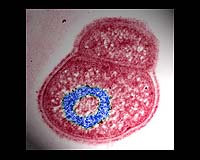
Rehovot - Jan 13, 2003 Weizmann Institute scientists have found what makes the bacterium Deinococcus radiodurans the most radiation-resistant organism in the world: The microbe's DNA is packed tightly into a ring. The findings, published in the January 10 issue of Science, solve a mystery that has long engaged the scientific community. The red bacterium can withstand 1.5 million rads -- a thousand times more than any other life form on Earth and three thousand that of humans. Its healthy appetite has made it a reliable worker at nuclear waste sites, where it eats up nuclear waste and transforms it into more disposable derivatives. The ability to withstand other extreme stresses, such as dehydration and low temperatures, makes the microbe one of the few life forms found on the North Pole. It's not surprising, then, that it has been the source of much curiosity worldwide, recently leading to a debate between NASA and Russian scientists -- the latter saying that it originated on Mars, where radiation levels are higher. Since DNA is the first part of a cell to be damaged by radiation and the most lethal damage is the breakage of both DNA strands, scientists have focused on DNA repair mechanisms to find the answer to the microbe's resilience. Cells, including human cells, can mend only very few such breaks in their DNA. Microbes, for example, can repair only three to five. Yet D. radiodurans can fix more than 200. Thus scientists believed that the microbe must possess uniquely effective enzymes that repair DNA. However, a series of experiments showed that the microbe's repair enzymes were very similar to those existing in ordinary bacteria. Using an assortment of optical and electron microscopy methods, Prof. Avi Minsky of the Weizmann Institute of Science's Organic Chemistry Department found that the microbe's DNA is organized in a unique ring that prevents pieces of DNA broken by radiation from floating off into the cell's liquids. Unlike other organisms, in which DNA fragments are lost due to radiation, this microbe does not lose genetic information because it keeps the severed DNA fragments tightly locked in the ring -- by the hundreds, if necessary. The fragments, held close, eventually come back together in the correct, original order, reconstructing the DNA strands. As exciting as these findings may be, they aren't expected to lead to the protection of humans from radiation. 'Our DNA is structured in a fundamentally different manner,' says Minsky. The results may, however, lead to a better understanding of DNA protection in sperm cells, where a ring-like DNA structure has also been observed.
More survival tricks Minsky's team also found that the microbe undergoes two phases of DNA repair. During the first phase the DNA fixes itself within the ring as described. It then performs an even more unusual stunt. The bacterium is composed of four compartments, each containing one copy of DNA. Minsky's group found two small passages between the compartments. After about an hour and a half of repair within the ring, the DNA unfolds and migrates to an adjacent compartment -- where it mingles with the copy of DNA residing there. Then the 'regular' repair machinery, common in humans and bacteria alike, comes into play -- repair enzymes compare between the two copies of DNA, using each as a template to fix the other. Since the DNA has already been through one phase of repair in which many of the breaks are fixed, this phase can be completed relatively easily.
...and a backup system The finding of a tightly packed ring made the team wonder how the bacterium could live and function under normal conditions. DNA strands must unfurl to perform their job of protein production. How can they do that if they can barely budge? This question led to the uncovering of another of the microbe's survival strategies: out of the four copies of DNA, there are always two or three tightly packed in a ring while the other copies are free to move about. Thus at any given moment there are copies of DNA that drive the production of proteins and others that are inactive but continuously protected. Minsky, along with other scientists, believes that the bacterium's answer to acute stresses evolved on Earth as a response to the harsh environments from which it might have emerged. It is one of the few life forms found in extremely dry areas. The unique defense mechanism that evolved to help it combat dehydration proves useful in protecting it from radiation. Deinococcus radiodurans was discovered decades ago in canned food that was sterilized using radiation. Red patches appeared in the cans -- colonies of the bacterium -- setting off questions as to how it could have survived. Though these questions have now been answered, the tide of speculation as to how these defense mechanisms evolved -- and where -- is likely to continue. Prof. Abraham Minsky's research is supported by Verband der Chemischen Industrie, Teva Pharmaceuticals, Israel and the Helen & Milton A. Kimmelman Center for Biomolecular Structure & Assembly. Community Email This Article Comment On This Article Related Links Weizmann Institute of Science Search SpaceDaily Subscribe To SpaceDaily Express Life Beyond Earth Lands Beyond Beyond - extra solar planets - news and science
 SETI Sets Its Sights On M Dwarfs
 Moffett Field CA (SPX) Nov 18, 2005
Scientists have been searching actively for signs of intelligent extraterrestrial civilizations for nearly half a century. Their main approach has been to point radio telescopes toward target stars and to "listen" for electronic transmissions from other worlds. |
|
|

| The content herein, unless otherwise known to be public domain, are Copyright 1995-2006 - SpaceDaily.AFP and UPI Wire Stories are copyright Agence France-Presse and United Press International. ESA PortalReports are copyright European Space Agency. All NASA sourced material is public domain. Additionalcopyrights may apply in whole or part to other bona fide parties. Advertising does not imply endorsement,agreement or approval of any opinions, statements or information provided by SpaceDaily on any Web page published or hosted by SpaceDaily. Privacy Statement |