|
 |
 |
 |
 |
 |
 |
 |
 |

 |
Rad-hardened CPU and RAM Will Ensure The Message Gets Heard From Mercury
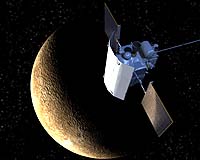
Farnborough UK (SPX) Sep 15, 2004 BAE Systems' radiation-hardened RAD6000 computers and solid state recorder assemblies headed for the planet Mercury August 3. The successful Delta II rocket launch from Cape Canaveral Air Force Station, Florida, marked the beginning of a 4.9-billion-mile, 6.5-year journey to Mercury. The spacecraft Messenger will study the planet's geologic history and overall structure. "NASA and Johns Hopkins University scientists are trying to understand the formation of Earth and other planets. Our RAD6000s and solid state recorders will support that mission," said Laura Burcin, BAE Systems Messenger program manager. BAE Systems' Information & Electronic Warfare Systems (IEWS) builds the RAD6000 high-performance 32-bit Reduced Instruction Set Computer (RISC) that operates in the heavily radiated space environment. The RAD6000 is based on the IBM RISC Single Chip (RSC) architecture. BAE Systems' computers and recorders provide on-board computing and data storage for the instruments and spacecraft control functions aboard Messenger. Messenger is set to become the first spacecraft to orbit Mercury. Following a route that includes two fly-bys of Venus, Messenger should reach Mercury by March 2011. During its year-long orbit, Messenger will provide the first images of the entire planet and collect detailed information on the composition and structure of Mercury's crust, its geologic history, the nature of its thin atmosphere, active earth-like magnetosphere, and the makeup of its core and polar materials. The RAD6000 is one of a family of radiation-hardened protected computers developed and produced by BAE Systems in Manassas, Virginia, with the support of NASA's Jet Propulsion Laboratory and the U.S. Air Force Research Laboratory. BAE Systems' microprocessors are also aboard two of NASA's most successful missions this year. The Mars Rovers "Opportunity" and "Spirit," which landed on the Red Planet in January, carried the RAD6000; and the Cassini spacecraft, which entered Saturn's orbit June 30, was guided by the Advanced Spaceborne Computer Module. The newest member of the processor family, the RAD750, will be used on the Deep Impact mission slated to launch later this year. Community Email This Article Comment On This Article Related Links BAE Systems Messenger Mission Home SpaceDaily Search SpaceDaily Subscribe To SpaceDaily Express Astronomy News from Skynightly.com
 Chris Van Allsburg Talks About Sci-Fi, Art And Education
 Washington DC (SPX) Nov 21, 2005
NASA is part of a partnership that provides educational materials based on the book and movie "Zathura" to help teachers get students excited about space and learning. |
|
|

| The content herein, unless otherwise known to be public domain, are Copyright 1995-2006 - SpaceDaily.AFP and UPI Wire Stories are copyright Agence France-Presse and United Press International. ESA PortalReports are copyright European Space Agency. All NASA sourced material is public domain. Additionalcopyrights may apply in whole or part to other bona fide parties. Advertising does not imply endorsement,agreement or approval of any opinions, statements or information provided by SpaceDaily on any Web page published or hosted by SpaceDaily. Privacy Statement |