|
 |
 |
 |
 |
 |
 |
 |
 |

 |
Radar Observations Refine The Future Motion Of Asteroid 2004 MN4
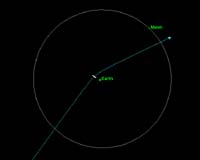
Puerto Rico (SPX) Feb 07, 2005 Radar observations taken at the Arecibo Observatory in Puerto Rico on January 27, 29, and 30 have significantly improved our estimate for the orbit of asteroid 2004 MN4 and changed the circumstances of the Earth close approach in 2029. On April 13, 2029, the predicted trajectory now passes within 5.7 Earth radii (36,350 km or 22,600 miles) of the Earth's center - just below the altitude of geosynchronous Earth satellites. However, an Earth collision in 2029 is still ruled out. The asteroid's motion subsequent to the 2029 Earth close approach is very sensitive to the circumstances of the close approach itself and a number of future Earth close approaches will be monitored as additional observations are received. However, our current risk analysis for 2004 MN4 indicates that no subsequent Earth encounters in the 21st century are of concern. In the accompanying diagrams, the most likely trajectory of asteroid 2004 MN4 is shown as a blue line that passes near the Earth on 13 April 2029. The second of the two figures is an enlarged view of the Earth close approach circumstances. Since the asteroid's position in space is not perfectly known at that time, the white dots at right angles to the blue line are possible alternate positions of the asteroid. Neither the nominal position of the asteroid, nor any of its possible alternative positions, touches the Earth, effectively ruling out an Earth impact in 2029. Based on albedo contraints by Andrew Rivkin and Richard Binzel (MIT), the diameter of the object is about 320 meters. At the time of the closest approach, the asteroid will be a naked eye object (3.3 mag.) traveling rapidly (42 degrees per hour!) through the constellation of Cancer. On average, one would expect a similarly close Earth approach by an asteroid of this size only every 1300 years or so. The passage of the asteroid by the Earth in 2029 alters its subsequent trajectory and causes its position uncertainty region to expand rapidly as it moves away from Earth (i.e., the line of white dots increases in extent). As a result, the asteroid's motion is much less predictable after the 2029 close Earth approach. Even so, the asteroid's uncertainty region is not large enough to extend to the moon as it passes by, and so a lunar impact is not possible. Lance Benner (JPL), Mike Nolan (NAIC), Steve Ostro (JPL), and Jon Giorgini (JPL) provided the Arecibo radar data that made these updated results possible. Community Email This Article Comment On This Article Related Links Possibility of an Earth Impact in 2029 Ruled Out for Asteroid 2004 MN4 Near-Earth Asteroid 2004 MN4 Reaches Highest Score To Date On Hazard Scale
SpaceDaily
 NASA'S Spitzer Finds Possible Comet Dust Around Dead Star
 Pasadena CA (SPX) Jan 12, 2006
NASA's Spitzer Space Telescope has spotted what may be comet dust sprinkled around the white dwarf star G29-38, which died approximately 500 million years ago. |
|
|

| The content herein, unless otherwise known to be public domain, are Copyright 1995-2006 - SpaceDaily.AFP and UPI Wire Stories are copyright Agence France-Presse and United Press International. ESA PortalReports are copyright European Space Agency. All NASA sourced material is public domain. Additionalcopyrights may apply in whole or part to other bona fide parties. Advertising does not imply endorsement,agreement or approval of any opinions, statements or information provided by SpaceDaily on any Web page published or hosted by SpaceDaily. Privacy Statement |