|
 |
 |
 |
 |
 |
 |
 |
 |

 |
Quantum Dot Lasers Makes All The Difference With 1 Dot
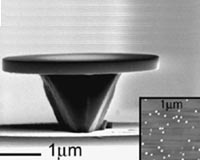
Washington DC (SPX) Apr 17, 2007 Physicists at the National Institute of Standards and Technology (NIST) and Stanford and Northwestern Universities have built micrometer-sized solid-state lasers in which a single quantum dot can play a dominant role in the device's performance. Correctly tuned, these microlasers switch on at energies in the sub-microwatt range. These highly efficient optical devices could one day produce the ultimate low-power laser for telecommunications, optical computing and optical standards. How small can a laser get? The typical laser has a vast number of emitters-electronic transitions in an extended crystal, for example-confined within an optical cavity. Light trapped and reflecting back and forth in the cavity triggers the cascade of coherent, laser light. But about a decade ago, researchers made the first quantum dot laser. Quantum dots are nanoscale regions in a crystal structure that can trap electrons and "holes," the charge carriers that transport current in a semiconductor. When a trapped electron-hole pair recombines, light of a specific frequency is emitted. Quantum-dot lasers have attracted attention as possible embedded communications devices not only for their small size, but because they switch on with far less power then even the solid-state lasers used in DVD players. In recent experiments*, the NIST-Stanford-Northwestern team made "microdisk" lasers by layering indium arsenide on top of gallium arsenide. The mismatch between the different-sized atomic lattices forms indium arsenide islands, about 25 nanometers across, that act as quantum dots. The physicists then etched out disks, 1.8 micrometers across and containing about 130 quantum dots, sitting atop gallium arsenide pillars. The disks are sized to create a "whispering gallery" effect in which infrared light at about 900 nanometers circulates around the disk's rim. That resonant region contains about 60 quantum dots, and can act as a laser. It can be stimulated by using light at a non-resonant frequency to trigger emission of light. But the quantum dots are not all identical. Variations from one dot to another mean that their emission frequencies are slightly different, and also change slightly with temperature as they expand or contract. At any one time, the researchers report, at most one quantum dot-and quite possibly none-has its characteristic frequency matching that of the optical resonance. Nevertheless, as they varied a disk's temperature from less than 10K to 50K, the researchers always observed laser emission, although they needed to supply different amounts of energy to turn it on. At all temperatures, they say, some quantum dots have frequencies close enough to the disk's resonance that laser action will happen. But at certain temperatures, the frequency of a single dot coincided exactly with the disk's resonance, and laser emission then needed only the smallest stimulation. It's not quite a single-dot laser, but it's a case where one quantum dot effectively runs the show. Community Email This Article Comment On This Article Related Links National Institute of Standards and Technology (NIST) Powering The World in the 21st Century at Energy-Daily.com Our Polluted World and Cleaning It Up China News From SinoDaily.com Global Trade News The Economy All About Solar Energy at SolarDaily.com Civil Nuclear Energy Science, Technology and News Understanding Time and Space
 Engineers Set New World Record In Generation Of High-Frequency Submillimeter Waves
 Los Angeles CA (SPX) Apr 17, 2007
Researchers at the UCLA Henry Samueli School of Engineering and Applied Science have achieved a new world record in high-frequency submillimeter waves. The record-setting 324-gigahertz frequency was accomplished using a voltage-controlled oscillator in a 90-nanometer complementary metal-oxide semiconductor (CMOS) integrated circuit, a technology used in chips such as microprocessors. |
|
|

| The content herein, unless otherwise known to be public domain, are Copyright 1995-2006 - SpaceDaily.AFP and UPI Wire Stories are copyright Agence France-Presse and United Press International. ESA PortalReports are copyright European Space Agency. All NASA sourced material is public domain. Additionalcopyrights may apply in whole or part to other bona fide parties. Advertising does not imply endorsement,agreement or approval of any opinions, statements or information provided by SpaceDaily on any Web page published or hosted by SpaceDaily. Privacy Statement |