
 |
 |
 |
 |
 |
 |
 |
 |
 |

 |
Quantifying Meteor False Alarm Rate Within Nuclear Test Monitoring System
Denver - Feb 14, 2003 A Los Alamos National Laboratory researcher is helping to provide an extra measure of confidence in an international array of listening posts that keep an ear out for clandestine nuclear weapons tests. Doug ReVelle of Los Alamos' Atmospheric, Climate and Environmental Dynamics Group today presented calculations showing the number of false alarms in international monitoring stations that can be attributed to meteors. ReVelle presented his findings at the American Association for the Advancement of Science's annual meeting in Denver. ReVelle and his Los Alamos colleagues operate a series of stations that listen for infrasonic signals - very low frequency sound waves that lie below the range of normal human hearing. The stations are part of an international monitoring system that is used to detect, among other things, rogue atomic tests. Such tests create infrasonic signals, and researchers can analyze data from the stations to pinpoint the location and even the magnitude of a clandestine blast. But incoming meteors also create infrasonic signals. When a meteor enters the atmosphere and continues traveling through it, it creates a pressure wave - the infrasonic signal. The pressure wave is akin to a pressure wave created by an explosion. Because of this, ReVelle often discusses meteor size in terms of explosive yield: the larger the yield, the greater the diameter of the meteor. Recently, ReVelle teamed up with researchers from Sandia National Laboratories, the University of Western Ontario, ET Space Systems and U.S. Space Command and looked at sound and light signatures from large meteors that had entered the atmosphere during the last eight years. From these data, the researchers were able to more precisely calculate the size and energy of incoming meteors. In addition, ReVelle was able to calculate the frequency of meteor encounters with the atmosphere. A meteor that's 100 feet in diameter - with the energy equivalency of a one-megaton explosion - enters the atmosphere about every 100 years. But smaller meteors enter more frequently. ReVelle looked at the number of meteors in the one-kiloton energy range (or meteors just under 10 feet in diameter) to determine the number of false alarms that might be seen on international monitoring stations worldwide. Based on his calculations, ReVelle found that individual monitoring stations would see, on the average, about five meteor signals a year. "This research will help give added confidence to the international monitoring system," ReVelle said. Community Email This Article Comment On This Article Related Links Los Alamos National Laboratory SpaceDaily Search SpaceDaily Subscribe To SpaceDaily Express Asteroid and Comet Impact Danger To Earth - News and Science
 NASA's Deep Impact Adds Color To Unfolding Comet Picture
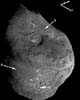 College Park MD (SPX) Sep 07, 2005
Painting by the numbers is a good description of how scientists create pictures of everything from atoms in our bodies to asteroids and comets in our solar system. Researchers involved in NASA's Deep Impact mission have been doing this kind of work since the mission's July 4th collision with comet Tempel 1. |
|
|

| The content herein, unless otherwise known to be public domain, are Copyright 1995-2006 - SpaceDaily.AFP and UPI Wire Stories are copyright Agence France-Presse and United Press International. ESA PortalReports are copyright European Space Agency. All NASA sourced material is public domain. Additionalcopyrights may apply in whole or part to other bona fide parties. Advertising does not imply endorsement,agreement or approval of any opinions, statements or information provided by SpaceDaily on any Web page published or hosted by SpaceDaily. Privacy Statement |

