|
 |
 |
 |
 |
 |
 |
 |
 |

 |
Quake Chaser Lazio�Sirad Now Aboard The ISS
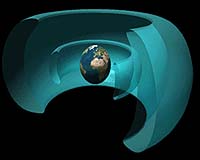
Rome, Italy (SPX) Apr 17, 2005 The Lazio-Sirad device has now arrived at the ISS, ready to confirm whether particle fluxes in the Van Allen belts are accurate harbingers of earthquakes on Earth. The experiment is installed on the International Space Station and its aim is to trace the slight variations of the so-called Van Allen belts that seem to occur before earthquakes. At the same time the experiment will gather data that will make possible the development of techniques of protection from radiation for astronauts. Roberto Vittori- who just arrived at the ISS- will carry out measurements. Our planet is incessantly bombarded with a rain of cosmic rays- charged stable particles, such as protons and electrons. Yet this flux is partly prevented by the Earth's magnetic field, which traps a part of it, outside its atmosphere, at an altitude between one hundred and a thousand kilometres. The distribution of these particles is not homogeneous, though: they place themselves in the Van Allen belts (after the name of the American physicist who discovered their existence in 1958). In whole, the Van Allen belts behave like a huge antenna, sensitive to the slightest variation of the Earth magnetic field. The surprising aspect is that preliminary measures gathered by Russian and American researchers over 15 years indicate that this natural antenna is able to reveal precursory phenomena of intense earthquakes four or five hours in advance. The Lazio-Sirad experiment is the first sensor designed to verify such a hypothesis in space, with Italian researchers showing strong interest in the project, as their country is exposed to significant seismic risk. How do the Earth's crust tensions reflect on the cosmic particles trapped outside the atmosphere? It was observed, through measures realized on Earth, that from the area of a future earthquake, electromagnetic waves of different frequency are generated in underground: among these, low-frequency waves can reach the atmosphere, cross it and interact with the particles trapped in the Van Allen belts. In this way, it is possible to produce rapid variations of the charged particles flux: measuring these variations, it would be possible to state the area in which the emission of low-frequency waves occurred, and so state where an earthquake is taking place. "In order to study the interaction between the Van Allen belts and seismic events, Lazio-Sirad uses sophisticated and innovative particle detectors based on the use of silica and scintillating plastics", explains Roberto Battiston, director of the Infn section in Perugia, who coordinated the realization of Lazio-Sirad project. (in close collaboration with Piergiorgio Picozza, director of the Infn section of Roma Tor Vergata, and with Vittorio Sgrigna, physics professor at the University of Roma Tre and spokesman of the Egle magnetometer.) "The measure of the particles trapped in the Van Allen belts will be related to the magnetic field measurements made through a precision magnetometer, called Egle, itself part of the Lazio-Sirad program. "Once the physics principal of the instrumentation, and its functioning in orbit, is verified, it'll then be possible to use new and cheap micro-satellites to monitor Earth.". In this circumstance the experiment Sileye3/Alteino - brought on board the ISS by Roberto Vittori during his previous mission "Marco Polo" - will be put back into service. "The experiment Sileye3/Alteino is particularly important to develop new materials and new technologies to protect man from being bombarded by cosmic particles during future lunar and interplanetary missions", explains Piergiorgio Picozza, who participated in Lazio-Sirad coordination, and is also spokesman of the Sileye3/Alteino experiment. "The Lazio-Sirad experiment has another important goal: to improve the study on the phenomenon of the light flashes, observed by the Mir and ISS astronauts, by analysing the interaction between the different kinds of cosmic rays and the astronauts' visual apparatus", explains Marco Casolino of the Infn section of Roma Tor Vergata, spokesman for the Lazio-Sirad part dedicated to the study of the light flashes. Lazio-Sirad will operate for at least six months from the start of data acquisition operations. The first results of the data analysis are expected by the end of 2005. Lazio-Sirad involves approximately 30 people- namely physicists, geophysicists, engineers and technicians from different institutes. The instrument was realized in a very short time (less than 6 months since the beginning of the project to the delivery to the Russian Space Agency on January the 25th), with respect to all the security procedures, and the verification and space qualification required by ESA and Energia. The project takes place in the context of the European mission Eneide, born from the collaboration between the Italian region Lazio, the Military Aeronautics, Alenia Spazio, the Chamber of Commerce of Rome, ESA, and Asi. The Eneide mission began last Friday from the space polygon in Baikonur, in Kazakhistan, then travelled aboard the Russian capsule Soyuz Tma to the ISS. All Eneide mission scientific experiments will be managed from the "Lazio user Centre", already working in the Infn section of Roma Tor Vergata. Lazio-Sirad was developed by the Infn sections and by the Universities of Perugia, Rome "Tor Vergata" and Rome Tre, in collaboration with the Infn National Laboratories of Frascati, the Serms University Laboratory of Terni, the MePhi Institute of Moscow, the Ferrari Bsn, Nergal and Airtec with the participation of Filas (Lazio Region). Community Email This Article Comment On This Article Related Links Istituto Nazionale di Fisica Nucleare SpaceDaily Search SpaceDaily Subscribe To SpaceDaily Express Tectonic Science and News
 Ash Continuing To Spew From Vanuatu Volcano
 Sydney (AFP) Dec 12, 2005
Thousands of tonnes of ash are continuing to spew from a volcano in Vanuatu, but officials said Monday the activity on the South Pacific nation was not likely to result in a major deadly eruption. |
|
|

| The content herein, unless otherwise known to be public domain, are Copyright 1995-2006 - SpaceDaily.AFP and UPI Wire Stories are copyright Agence France-Presse and United Press International. ESA PortalReports are copyright European Space Agency. All NASA sourced material is public domain. Additionalcopyrights may apply in whole or part to other bona fide parties. Advertising does not imply endorsement,agreement or approval of any opinions, statements or information provided by SpaceDaily on any Web page published or hosted by SpaceDaily. Privacy Statement |