|
 |
 |
 |
 |
 |
 |
 |
 |

 |
Purdue Works To Transform Ebola Virus From Killer To Healer
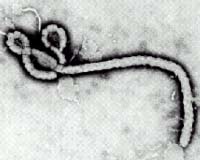
West Lafayette - Dec 18, 2002 By redesigning the shell of Ebola, Purdue University researchers have transformed the feared virus into a benevolent workhorse for gene therapy � and as one of the first gene bearers that can be inhaled rather than injected, it might prove valuable in the fight against lung disease. While replacing the infection-causing genes inside an ordinarily harmful retrovirus with helpful genetic material is a relatively common research practice, David Sanders and his colleagues have gone a step beyond this technique. The group, which also includes Anthony Sanchez of the Centers for Disease Control and Purdue graduate student Scott Jeffers, has hit upon a way to simplify Ebola's outer shell as well, rendering it more easily produced in a laboratory and more effective at delivering genes to defective cells. Since unmodified Ebola enters through, and attacks, the lungs, defective lung cells could benefit most from therapy based on this discovery. "We are adding a new tool to the gene-therapy toolbox," said Sanders, associate professor of biological sciences in Purdue's School of Science. "Up to this point, modified retroviruses could only be injected. Now we have a potential method of treating lung conditions with an inhaled retrovirus that is more easily produced in the lab than the version found in nature." The research appeared in Sunday's (12/15) Journal of Virology. Gene therapy is the introduction of new genetic material into an organism for medical benefit, such as correcting the genetic defect responsible for cystic fibrosis. While viruses are often thought of as harmful, their ability to introduce new genes into cells gives them great potential for gene therapy. Ordinarily, a virus injects its own genetic material into a cell, but scientists have learned how to "borrow" the outer shell from a harmful virus and fill it up with other, beneficial genetic material that heals rather than harms the recipient. These shells are made of proteins, enormously complex molecules formed from long strings of amino acids. It is these proteins that allow a virus to attach itself to, and penetrate, cell membranes, but their complexity creates difficulty for researchers. "Recreating shells in a laboratory is an involved and time-consuming business," Sanders said. "We wanted to find a way to reduce our workload." To a viral researcher such as Sanders, a protein's amino acid string can be read like a car's schematic. If a section of string appears to recur in many different viruses, it's a safe bet that part of the string serves some essential function. "If you'd never seen a car but wanted to know what you'd need to build one, you might look at blueprints for lots of models and see what parts were common to all cars," Sanders said. "You might conclude that while an engine was essential, you could still build a working automobile without power windows. We do the same sort of thing with viruses to construct shells that will do what we want." Sanders' team examined the variant proteins that made up the shells of all the different strains of Ebola, and they noticed a particular string of amino acids kept cropping up. "All strains of Ebola have a protein shell made of a sequence of about 675 amino acids, and we noticed that one section of that long string � of 181 amino acids, to be precise � had a strikingly similar chemical character," Sanders said. "That told us that section probably served the same biochemical function in each strain of the virus." But while the similarities seemed to indicate that the section was important, the group noticed a subtle difference that made them conclude otherwise. While the amino acids were more or less the same, they appeared in different sequences from strain to strain. "We think that section of the string is only important to disguise the virus from the immune system," Sanders said. "It's a protective paint job, not a piston. Our viruses don't need to hide from the immune system because they don't replicate themselves inside the cells they invade � they switch good genes for bad and disappear. So we reasoned it was unnecessary to include that section in our viruses � we could get our Ebola through the assembly line faster if the paint job were skipped." Armed with this hypothesis, the group removed those 181 amino acids from the string and built a shell from the remainder. The team's efforts paid off: Their modified Ebola shell not only proved effective at attaching itself to cell membranes but also delivered its genetic payload more efficiently. "We managed to cut more than 25 percent of the string and found the retrovirus would transfer genes even more effectively than one with a 'natural' Ebola coat," Sanders said. "We now have a vehicle that can potentially bring genes directly to the lungs, which was not feasible before." The next step will be attempting to correct certain defective genes within lung cells. Cystic fibrosis and lung cancer are diseases that Sanders' group hopes to tackle. "Cystic fibrosis is the most common serious genetic disease among Caucasians in the world," Sanders said. "Lung cancer is the leading cancer killer in both men and women, so therapies to counter these diseases would be a wonderful achievement." For the moment, Sanders said he is pleased that virus shells can be simplified and remain effective tools. "It's encouraging news for other gene-therapy researchers," he said. "If we can simplify other virus shells as well, it will mean less time and energy in the lab, which translates into savings for the medical industry." Community Email This Article Comment On This Article Related Links Purdue University SpaceDaily Search SpaceDaily Subscribe To SpaceDaily Express Dirt, rocks and all the stuff we stand on firmly
 Environmental Damage Threatens Human Health
 Bangkok (AFP) Dec 9, 2005
Environmental damage threatens human health and may have contributed to the spread of new diseases like bird flu and SARS, the World Health Organization said in a report Friday. |
|
|

| The content herein, unless otherwise known to be public domain, are Copyright 1995-2006 - SpaceDaily.AFP and UPI Wire Stories are copyright Agence France-Presse and United Press International. ESA PortalReports are copyright European Space Agency. All NASA sourced material is public domain. Additionalcopyrights may apply in whole or part to other bona fide parties. Advertising does not imply endorsement,agreement or approval of any opinions, statements or information provided by SpaceDaily on any Web page published or hosted by SpaceDaily. Privacy Statement |