|
 |
 |
 |
 |
 |
 |
 |
 |

 |
Purdue Engineers Study Corrosion-Resistant Material For Bridges
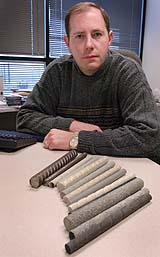
West Lafayette IN (SPX) Dec 13, 2005 Civil engineers at Purdue University are developing a new generation of bridges that will contain corrosion-resistant plastic bars reinforced with glass or carbon fibers, promising to double the number of years between expensive repairs. Concrete-strengthening steel bars called "rebar," currently used in bridges, are susceptible to corrosion, especially in the "deck," which is the uppermost portion of the bridge that serves as the riding surface. The rebar embedded in bridge-deck concrete is exposed to de-icing road salt that seeps through cracks in the pavement, said Robert Frosch, an associate professor of civil engineering. "Bridge decks generally have to be replaced every 20 or 30 years, which is very expensive, but replacing the rebar with bars made out of fiber-reinforced polymers could extend the lifetime of a deck to perhaps 50 to 100 years," Frosch said. "If we could make bridges last longer, we could do other things with the money that now has to be spent on these repairs." Purdue civil engineers have installed a bridge deck containing the fiber-reinforced polymer bars in a span over Interstate 65 at Thayer Road near Demotte, Ind. It is the first fiber-reinforced polymer-bar bridge deck ever installed in an Indiana bridge. As steel rebar corrodes, it causes the rebar to expand, eventually causing chunks of concrete to break away from the bridge deck. This results in driving hazards and increases the exposure of underlying bridge components to road salt, which leads to more corrosion. The salty water also causes steel bars in both the upper and bottom portions of the bridge deck to act as the negative and positive poles of a battery, respectively, increasing the rate of corrosion. "This battery effect accelerates corrosion in the bridge deck, but replacing the steel rebar in the upper portion of the deck with fiber-reinforced polymer bars eliminates one of the poles and shuts down this battery effect," Frosch said. The fiber-reinforced polymer bars must be extensively tested, however, before they can be used to replace steel rebar in bridge deck construction, he said. The bars are made of a plastic polymer that is reinforced by fibers of glass, carbon or another material. "Glass is the least expensive right now, at about a dollar a pound," Frosch said. The price of carbon fibers has dropped consistently since the material was first developed for exotic applications, such as its use in construction of stealth aircraft. "Over the years it's gone from $500 a pound to $5 a pound and can still come down from there," Frosch said. "The more you use it, the cheaper it becomes." At the same time, the cost of steel has more than doubled in recent years. Frosch worked with doctoral student Cihan Pay to analyze how well the new synthetic bars perform. As the bars are embedded lengthwise inside concrete structures, they often have to be spliced by overlapping the bars. "We call this overlapping the splice length of the bars," Frosch said. "The longer the splice length, the greater amount of force the beam can withstand before it breaks." The researchers are studying how much splice length is needed for specific applications, using hydraulic machinery to exert force on test beams until they fail. "We're studying a range all the way from 12 inches up to about 54 inches of splice length," Frosch said. The research is funded by the Federal Highway Administration through the Joint Transportation Research Program of Purdue and the Indiana Department of Transportation and is being conducted at Purdue's Robert L and Terry L Bowen Civil Engineering Laboratory for Large Scale Research. Data collected from the experiments will yield important information about how much force the bars can withstand when different splice lengths are used. A portion of Pay's research delved into the fundamental physics of how the concrete bonds to the overlapping bars. Pay used data from the research to develop mathematical equations for a new "fundamental model" that describes the precise performance characteristics depending on different splice lengths. "Bond failure is very bad," said Pay, who recently graduated. "When it happens, there is no warning. People have no time to react." The model may be used in the future by the American Concrete Institute in new guidelines for the design and construction of concrete structures with fiber-reinforced polymer bars. "These are the guidelines for how engineers design structures using these bars," Frosch said. "The report will contain a chapter on splices and development of reinforcement." Pay's equation for bond strength will apply to all materials, including steel bars. "It's going to be one simple equation that works across the board," he said. In the Thayer Road bridge over I-65, sensors have been inserted in the deck to constantly record data that will be used to learn how well the structure is performing. The data can be remotely monitored from Purdue. "Strain gauges provide a tool to measure the amount of stress in the bars," Frosch said. "Gauges are attached inside the bridge deck as well as on the girders under the deck." The researchers eventually will publish papers detailing how the bridge deck responds when subjected to actual traffic. Several states have built bridges with fiber-reinforced polymer bars, but the material is still considered experimental and is not in widespread use. Frosch said new research will provide a means for increased use of these materials. Community Email This Article Comment On This Article Related Links Federal Highway Administration Purdue University Bowen Lab SpaceDaily Search SpaceDaily Subscribe To SpaceDaily Express Space Technology News - Applications and Research
 NGC Chosen To Proceed With Developing Solid-State Laser Technology For Military Applications
 Redondo Beach CA (SPX) Jan 09, 2006
Northrop Grumman Corporation has been selected to develop "military-grade," solid-state laser technology that is expected to pave the way for the U.S. military to incorporate high-energy laser systems across all services, including ships, manned and unmanned aircraft, and ground vehicles. |
|
|

| The content herein, unless otherwise known to be public domain, are Copyright 1995-2006 - SpaceDaily.AFP and UPI Wire Stories are copyright Agence France-Presse and United Press International. ESA PortalReports are copyright European Space Agency. All NASA sourced material is public domain. Additionalcopyrights may apply in whole or part to other bona fide parties. Advertising does not imply endorsement,agreement or approval of any opinions, statements or information provided by SpaceDaily on any Web page published or hosted by SpaceDaily. Privacy Statement |