|
 |
 |
 |
 |
 |
 |
 |
 |

 |
Purdue Engineers Lay Groundwork For Vertically Oriented Nanoelectronics
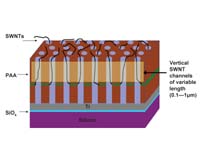
West Lafayette IN (SPX) Aug 04, 2006 Engineers at Purdue University have developed a technique to grow individual carbon nanotubes vertically on top of a silicon wafer, a step toward making advanced electronics, wireless devices and sensors using nanotubes by stacking circuits and components in layers. The technique might help develop a method for creating "vertically oriented" nanoelectronic devices, the electronic equivalent of a skyscraper, said Timothy S. Fisher, an associate professor of mechanical engineering who is leading the work with Timothy D. Sands, the Basil S. Turner Professor of Engineering. "Verticality gives you the ability to fit more things into the same area, so you can add more and more layers while keeping the footprint the same size or smaller," Fisher said. "But before we can even think about using nanotubes in electronics, we have to learn how to put them where we want them." The engineers first created a "thin film" containing two layers of aluminum sandwiching one ultra-thin layer of iron using electron-beam evaporation, a standard process employed in the semiconductor industry. The engineers then used "anodization," a process that causes metals to oxidize - like rusting - to selectively create tiny cylindrical cavities and turn the film into a "porous anodic alumina template" less than 1/100th the width of a human hair in thickness. During the process, an electric field was used to form a precisely aligned array of nanoscopic holes, turning aluminum into porous alumina, the oxidized form of aluminum also known as aluminum oxide. A mixture of hydrogen and methane gas was then flowed into the template's holes, and microwave energy was applied to break down the methane, which contains carbon. The iron layer acted as a catalyst that prompted the carbon nanotubes to assemble from carbon originating in the methane, and the tubes then grew vertically out of the cavities. "You get a single nanotube in each pore, and that's important because we can start to think about controlling how and where to put nanotubes to vertically integrate them for future electronic devices and sensing technologies," Sands said. Findings are detailed in a research paper that appeared July 11 in the journal Nanotechnology. The paper was written by graduate students Matthew R. Maschmann and Aaron D. Franklin; postdoctoral research associate Placidus Amama; Dmitri Zakharov, a staff scientist at Purdue's Birck Nanotechnology Center; Eric Stach, an associate professor of materials engineering; Sands and Fisher. "The pores in the template and the nanotubes that grow in the pores really self-assemble once you set the process in motion," said Stach, who used two types of electron microscopes to take images of the nanotubes emerging vertically from the cavities. The research is based at the Birck Nanotechnology Center in Purdue's Discovery Park, the university's hub for interdisciplinary research. The cavities form within seconds, and the nanotubes take several minutes to finish growing. The holes vary in width from 30-50 nanometers. A nanometer, or billionth of a meter, is about as long as 10 atoms strung together. Carbon nanotubes, which were discovered in the early 1990s, might enable industry to create new types of transistors and more powerful, energy-efficient computers, as well as ultra-thin "nanowires" for electronic circuits. Reaching that potential promise, however, won't be possible unless carbon nanotubes can be integrated with other parts of circuitry and devices, Sands said. The experiments at Purdue yielded both single- and double-walled nanotubes, meaning they are made of either one or two single sheets of carbon atoms, yielding tubes about one nanometer in diameter. Researchers will continue the work in efforts to understand which conditions are needed to produce single-wall tubes versus the double-wall variety and to learn how to produce more of one or the other. Other researchers previously have made the templates, but the Purdue researchers are the first to add a layer of iron, which was Maschmann's idea, Fisher said. "He was told by many people, including me, that it probably wouldn't work," Fisher said. "We were surprised to see that the nanotubes grow from the sidewall of the hole and then extend vertically." Early applications are most likely in wireless computer networks and radar technology. Long-term uses are possible in new types of transistors, other electronic devices and circuits. The research is funded by NASA, through the Purdue-based Institute for Nanoelectronics and Computing. Community Email This Article Comment On This Article Related Links Timothy Fisher Timothy Sands Birck Nanotechnology Center Discovery Park Nano Technology News From SpaceMart.com Computer Chip Architecture, Technology and Manufacture
 Nano Helps Keep Cells Alive
 New York (UPI) Jul 26, 2006
Encasing living cells in networks of silica and fatty layers only nanometers or billionths of a meter in size could help keep them alive longer for use in novel chemical factories or sensors, experts tell UPI's Nano World. |
|
|

| The content herein, unless otherwise known to be public domain, are Copyright 1995-2006 - SpaceDaily.AFP and UPI Wire Stories are copyright Agence France-Presse and United Press International. ESA PortalReports are copyright European Space Agency. All NASA sourced material is public domain. Additionalcopyrights may apply in whole or part to other bona fide parties. Advertising does not imply endorsement,agreement or approval of any opinions, statements or information provided by SpaceDaily on any Web page published or hosted by SpaceDaily. Privacy Statement |