|
 |
 |
 |
 |
 |
 |
 |
 |

 |
Purdue Calumet Professor To Forge Sword From Meteorite
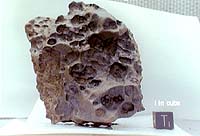
Hammond - March 27, 2001 Slaying dragons by sword may be the stuff of Dark Ages folklore. But in 21st century America, a Purdue University Calumet engineering professor is doing his part to take the art of "dragon slaying" to a new level. Sometime this spring, Harvey Abramowitz of Chicago, a metallurgist and associate professor of mechanical engineering, intends to draw from the world of outer space to contribute to the creation of the strongest, toughest broadsword ever made: "The Dragonslayer." Working with colleagues from Northwestern University, Abramowitz' role is to refine iron from a meteorite in a Purdue Calumet metallurgy laboratory for "The Dragonslayer" blade. "It will be made out of a new metal alloy that will be stronger than any other sword blade," Abramowitz, a New York City native, said about the one-of-a-kind sword. "The idea is to create "The Dragonslayer" in such a way that it is stronger than either a Samurai sword or a Damascus sword - and give it dragon-slaying mythical properties." Extracting iron from a meteorite to create the blade is intended to enhance the mystical dimension of the sword - thereby increasing the sword's appeal among collectors, said Abramowitz. The plan is to create just one Dragonslayer and auction it off. "Sword collectors would pay handsomely for such an artifact," said Abramowitz, a 14-year faculty member, who came to Purdue Calumet after having served as a research engineer at Inland Steel. Beyond the sword's mythical nature, the project has scholarly significance. "The team that I worked with was able to demonstrate, using a tensile testing machine, that the new alloy could cut through a hunting knife equivalent to a Samurai sword," Abramowitz said. "Finite element analysis computer modeling of the new alloy blade, done as a senior design project, had predicted this. So (our) team validated the model." Abramowitz became involved in the project when he spent a sabbatical leave last spring working with Northwestern colleague Greg Olson, who also is chief science officer of QuesTek Innovations, a company actively involved in the computer design and marketing of new alloys. Abramowitz, whose specialty research fields include materials engineering and extractive/chemical metallurgy, said he became interested in working with Olson. "I read an article in a metallurgical journal about him and thought I would like to work with Greg on some of his projects," he said. As part of a Steel Research Group headed by Olson, Abramowitz did just that. Among other projects in which he participated were:
Abramowitz teaches courses in materials engineering, engineering design and environmental engineering. He also is an industrial consultant. Community Email This Article Comment On This Article Related Links Purdue University SpaceDaily Search SpaceDaily Subscribe To SpaceDaily Express Space
 Satellite Launch To Boost DTH In India
 Calcutta, India (SPX) Dec 28, 2005
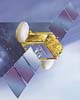
The successful launch Thursday of India's heaviest satellite from spaceport of Kourou in French Guyana may have boosted the country's space research efforts to yet another level, but it has also lifted the spirits of at least three Direct-To-Home televisions broadcasters, one of which has been waiting for years to launch its services in India. |
|
|

|
|
|
|
|
|
|
|
|
|
|
|
| The content herein, unless otherwise known to be public domain, are Copyright 1995-2006 - SpaceDaily.AFP and UPI Wire Stories are copyright Agence France-Presse and United Press International. ESA PortalReports are copyright European Space Agency. All NASA sourced material is public domain. Additionalcopyrights may apply in whole or part to other bona fide parties. Advertising does not imply endorsement,agreement or approval of any opinions, statements or information provided by SpaceDaily on any Web page published or hosted by SpaceDaily. Privacy Statement |