|
 |
 |
 |
 |
 |
 |
 |
 |

 |
Pulsar Find Boosts Hope For Gravity-Wave Hunters
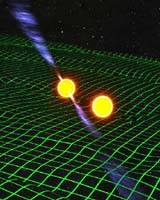
Canberra - Dec 04, 2003 Neutron star pairs may merge and give off a burst of gravity waves about six times more often than previously thought, scientists report in today's issue of the journal Nature [4 December]. If so, the current generation of gravity-wave detectors might be able to register such an event every year or two, rather than about once a decade - the most optimistic prediction until now. Gravity waves were predicted by Einstein's general theory of relativity. Astronomers have indirect evidence of their existence but have not yet detected them directly. The revised estimate of the neutron-star merger rate springs from the discovery of a double neutron-star system, a pulsar called PSR J0737-3039 and its neutron-star companion, by a team of scientists from Italy, Australia, the UK and the USA using the 64-m CSIRO Parkes radio telescope in eastern Australia. Neutron stars are city-sized balls of a highly dense, unusual form of matter. A pulsar is a special type - a spinning neutron star that emits radio waves. PSR J0737-3039 and its companion are just the sixth known system of two neutron stars. They lie 1600-2000 light-years (500-600 pc) away in our Galaxy. Separated by 800,000 km (500,000 miles) - about twice the distance between the Earth and Moon - the two stars orbit each other in just over two hours. Systems with such extreme speeds have to be modelled with Einstein's general theory of relativity. "That theory predicts that the system is losing energy in the form of gravity waves," said lead author Marta Burgay, a PhD student at the University of Bologna. "The two stars are in a 'dance of death', slowly spiralling together." In 85 million years the doomed stars will fuse, rippling spacetime with a burst of gravity waves. "If the burst happened in our time, it could be picked up by one of the current generation of gravitational wave detectors, such as LIGO-I, VIRGO or GEO" said team leader Professor Nicolo D'Amico, Director of the Cagliari Astronomical Observatory in Sardinia. The previous estimate of the neutron-star merger rate was strongly influenced by the characteristics of just one system, the pulsar B1913+16 and its companion. PSR B1913+16 was the first relativistic binary system discovered and studied, and the first used to show the existence of gravitational radiation. PSR J0737-3039 and its companion are an even more extreme system, and now form the best laboratory for testing Einstein's prediction of orbital shrinking. The new pulsar also boosts the merger rate, for two reasons. It won't live as long as PSR B1913+16, the astronomers say. And pulsars like it are probably more common than ones like PSR B1913+16. "These two effects push the merger rate up by a factor of six or seven," said team member Dr. Dick Manchester of CSIRO's Australia Telescope National Facility, which operates the Parkes telescope. But the actual numerical value of the merger rate depends on assumptions about how pulsars are distributed in our Galaxy. "Under the most favourable distribution model, we can say at the 95% confidence level that this first generation of gravitational wave detectors could register a neutron star merger every one to two years," said Dr. Vicky Kalogera, Assistant Professor of Physics and Astronomy at Northwestern University in Illinois, USA. Dr. Kalogera and colleagues Chunglee Kim and Duncan Lorimer have modelled binary coalescence rates using a range of assumptions. The new result is "good news for gravity-wave astronomers," according to team member Professor Andrew Lyne, Director of the Jodrell Bank Observatory of the University of Manchester in the UK. "They may get to study one of these cosmic catastrophes every few years, instead of having to wait half a career," he said. M. Burgay, N. D'Amico, A. Possenti, R.N. Manchester, A.G. Lyne, B.C. Joshi, M.A. McLaughlin, M. Kramer, J.M. Sarkissian, F. Camilo, V. Kalogera, C.Kim & D.R. Lorimer. "An increased estimate of the merger rate of double neutron stars from observations of a highly relativistic system". Nature 426, 531-533 (2003). Community Email This Article Comment On This Article Related Links CSIRO SpaceDaily Search SpaceDaily Subscribe To SpaceDaily Express Understanding Time and Space
 Unified Physics Theory Explains Animals Running Flying And Swimming
 Durham NC (SPX) Jan 05, 2006
A single unifying physics theory can essentially describe how animals of every ilk, from flying insects to fish, get around, researchers at Duke University's Pratt School of Engineering and Pennsylvania State University have found. The team reports that all animals bear the same stamp of physics in their design. |
|
|

| The content herein, unless otherwise known to be public domain, are Copyright 1995-2006 - SpaceDaily.AFP and UPI Wire Stories are copyright Agence France-Presse and United Press International. ESA PortalReports are copyright European Space Agency. All NASA sourced material is public domain. Additionalcopyrights may apply in whole or part to other bona fide parties. Advertising does not imply endorsement,agreement or approval of any opinions, statements or information provided by SpaceDaily on any Web page published or hosted by SpaceDaily. Privacy Statement |