|
 |
 |
 |
 |
 |
 |
 |
 |

 |
Pulsar Causes Mysterious Collision With Stellar Winds
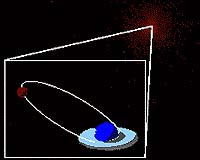
Paris, France (SPX) Feb 28, 2006 Astronomers using ESA's XMM-Newton spacecraft have witnessed a collision between a pulsar and a ring of gas around a neighboring star. The rare passage, in which the pulsar plunged into and through its companion's ring, illuminated the sky in gamma-rays and X-rays. The astronomers think the event could reveal insights into the origin and content of pulsar winds - phenomena whose source has remained mysterious. Reporting in the Monthly Notices of the Royal Astronomical Society, European astronomers described the event as a natural version of the Deep Impact probe's collision with Comet Tempel 1 last July 4 - but on an immensely bigger scale. They said their analysis, based on a new observation with XMM-Newton, plus a large amount of archived data, should lead to a better understanding of what drives pulsar nebulae, such as the Crab and Vela. "Despite countless observations, the physics of pulsar winds have remained an enigma," said lead author Masha Chernyakova, of the Integral Science Data Centre in Versoix, Switzerland. "Here we had the rare opportunity to see pulsar wind clashing with stellar wind. It is analogous to smashing something open to see what's inside." A pulsar is a fast-spinning core of a collapsed star that was once about 10 to 25 times more massive than the Sun. The dense core contains about a solar mass compacted into a sphere only about 20 kilometers (13 miles) across. The object in the observation, called PSR B1259-63, is a radio pulsar, which means most of the time it emits only radio waves. The binary system lies in the general direction of the Southern Cross about 5,000 light-years away. Pulsar wind comprises material flung away from the pulsar. Scientists have engaged in an ongoing debate about how energetic the winds are and whether they consist of protons or electrons. The team observed PSR B1259-63 orbiting a 'Be' star named SS 2883, which is bright and visible to amateur astronomers. 'Be' stars, named because they exhibit certain spectral characteristics related to the element beryllium, tend to be a few times more massive than the Sun, but they rotate at astonishing speeds - so fast that their equatorial regions bulge and they become flattened spheres. They also consistently fling off gas, which settles into an equatorial ring around the star, giving it an appearance similar to Saturn and its rings. The pulsar plunges into the Be star's ring twice during its 3.4-year elliptical orbit; but the plunges are only a few months apart, just before and after periastron - the point when the two objects in orbit are closest to each other. The plunges emit X-rays and gamma rays, and XMM-Newton detects the X-rays. "For most of the 3.4-year orbit, both sources are relatively dim in X-rays and it is not possible to identify characteristics in the pulsar wind," said co-author Andrii Neronov. "As the two objects draw closer together, sparks begin to fly." The team collected the XMM-Newton data nearly simultaneously with an observation by the High Energy Stereoscopic System, the new ground-based gamma-ray telescope in Namibia. Announced last year, the HESS observation was puzzling, because the gamma-ray emissions fell to a minimum at periastron and had two maximums, just before and after the periastron - the opposite of what scientists were expecting. The XMM-Newton observation supports the HESS observation by showing how the maximums were generated by the double plunging into the Be star's ring. By combining these two observations with radio observations from the last periastron event, the scientists have compiled a complete picture of this system. Tracing the rise and fall of X-rays and gamma rays day after day as the pulsar dug through the Be star's disk, the scientists concluded the wind of electrons - at an energy level of 10-100 million electron volts - is responsible for the observed X-ray light. Although radiation of 10-100 MeV is energetic, it is about 1-million times less than what was expected: 100 trillion electron volts. Even more puzzling is the multi-TeV gamma-ray emission. Although it must emanate from the pulsar wind, the scientists said it is not being produced in an expected way. "The only fact that is crystal clear at the moment is that this is the pulsar system to watch if we want to understand pulsar winds," Chernyakova said. "Never have we seen pulsar wind in such detail. We are continuing with theoretical models now. We have some good explanation of the radio-to-TeV-gamma-ray behavior of this funny system, but it is still under construction." Chernyakova's co-authors include his colleague Andrii Neronov at ISDC; Alexander Lutovinov of IKI in Moscow, Russia; Jerome Rodriguez at CEA Saclay in Gif sur Yvette, France, and Simon Johnston of ATNF in Epping, Australia. Community Email This Article Comment On This Article Related Links Pulsar Paper XMM-Newton ESA Stellar Chemistry, The Universe And All Within It
 Milky Way And Andromeda Galaxy Share Common History
 Pasadena CA (SPX) Feb 28, 2006
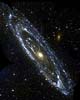
Researchers said Tuesday they have found evidence that the Andromeda and Milky Way galaxies probably are quite similar in the way they evolved - at least over their first several billion years. |
|
|

| The content herein, unless otherwise known to be public domain, are Copyright 1995-2006 - SpaceDaily.AFP and UPI Wire Stories are copyright Agence France-Presse and United Press International. ESA PortalReports are copyright European Space Agency. All NASA sourced material is public domain. Additionalcopyrights may apply in whole or part to other bona fide parties. Advertising does not imply endorsement,agreement or approval of any opinions, statements or information provided by SpaceDaily on any Web page published or hosted by SpaceDaily. Privacy Statement |