|
 |
 |
 |
 |
 |
 |
 |
 |

 |
Protecting America's Spacecraft
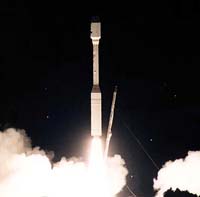
Kirtland AFB - Aug 21, 2003 Since Sputnik first circled the earth nearly half a century ago, aerospace engineers have searched for better ways to protect spacecraft from the violent engine vibrations transmitted through the rocket body during launch. In some cases, satellites have actually been shaken apart inside their payload shroud before reaching orbit and their mission. Not only costly, but also ruined payloads can be potentially disastrous to national defense in wartime when rapid response to orbit has to be done right the first time -- every time. Scientists here at the Air Force Research Laboratory (AFRL), working with their CSA Engineering, Boeing, and Delta Velocity Corporation partners, may have found a way to save those payloads. Launched today (Wednesday, 20 August 2003) on a sounding rocket off the coast of Virginia from Wallops Island Flight Facility, AFRL's Vibro-Acoustic Launch Protection Experiment (VALPE-2) carried new "active isolation and acoustic mitigation" technology that counteracts vibrations produced by the rocket motor and sound waves during launch. And it uses something much like a home stereo speaker to do it. "Much of our work here in the Space Vehicles Directorate over the past few years has dealt with controlling unwanted launch vibrations that damage sensitive spacecraft components," said Dr. Kyle Henderson, manager of AFRL's Advanced Spacecraft Mechanisms Program. "In the past, we developed what was called the SoftRide passive isolation system for launch vehicles with CSA Engineering, which reduced vibrational disturbances at a ratio of 5 to 1. Softride, which has flown on Taurus and Minotaur launch vehicles, performs very much like the shock absorbers on your car, using the same principle that soaks up the jarring shocks annoying to passengers when driving on a bumpy road," Henderson said. But hybrid active-passive vibration isolation is a more advanced process. Such systems may reduce vibrations at a ratio of 10 to 1. Henderson put it this way: "An active isolation system, like today's experiment, improves upon Softride's passive technology by actively pushing and pulling to provide better isolation performance." To do this, the hybrid isolation system on VALPE-2 uses a "voice-coil actuator" similar to that found in a speaker in your home stereo system. For example, if you watch a sub-woofer when sound is being produced, you will see that the speaker cone itself actually moves in and out, keeping time, so to speak, with the base tones heard. This is that foot-tapping "beat." Driven by a magnet, the speaker cone "pumps" in and out to alternately compress and decompress the air, the actions required to 'spread' the sound throughout the room. VALPE-2 uses the same principle to move the payload actively. A similar device developed with Boeing -- called the adaptive Vibro-Acoustic Device -- pushes against the air inside the payload shroud and compensates for harmful oncoming sound waves created at launch. In effect, VALPE-2 dampens the harsh environment considerably by counteracting ambient vibration and "noise" and prevents payload damage. Another type of coil-based isolation system aboard VALPE-2, and developed by Boeing, is an experimental power source called regenerative electronics. This converts motion to the energy (launch vibrations into the electricity) needed to provide active isolation during the violent shock of separating rocket stages during the flight to orbit. VALPE-2 is also the first flight of a new AFRL composite fairing (protective payload shroud) called ChamberCore. Built by Delta Velocity, this technology, because of its unique construction characteristics, may also reduce unwanted sound. In the 1971, some researchers estimated that nearly half of all payloads that failed in the first 24 hours came from vibro-acoustic stresses during launch. Consequently, spacecraft designers had to beef up their work, and in some cases added nearly forty percent worth of structural bulk to a spacecraft just to survive launch. AFRL has spent about $1 million on VALPE-2, an investment that may help put an end to payload losses by using technology that also reduces the mass and weight of a spacecraft. And weight saving is a key contributor to lowering the cost of access to space, especially when you figure that it runs about $10,000 to put one pound of payload into orbit. Reduce the weight, and you can use smaller launch rockets. "I suppose what we are really doing is "quieting" the air all around our payload," Henderson summarized. "And it is this protective cushion that has the potential to save our industry millions of dollars every year by getting payloads into orbit safety and cheaply." Community Email This Article Comment On This Article Related Links SpaceDaily Search SpaceDaily Subscribe To SpaceDaily Express Rocket Science News at Space-Travel.Com
 Successful First Test For Vega's Zefiro 9 Engine
 Paris, France(ESA) Dec 28, 2005
Flames, smoke and a deafening noise accompanied the first firing test of Vega's Zefiro 9 third-stage solid rocket motor. A first examination of the data indicates that everything went well at the test carried out yesterday at Salto de Quirra in southeast Sardinia. |
|
|

| The content herein, unless otherwise known to be public domain, are Copyright 1995-2006 - SpaceDaily.AFP and UPI Wire Stories are copyright Agence France-Presse and United Press International. ESA PortalReports are copyright European Space Agency. All NASA sourced material is public domain. Additionalcopyrights may apply in whole or part to other bona fide parties. Advertising does not imply endorsement,agreement or approval of any opinions, statements or information provided by SpaceDaily on any Web page published or hosted by SpaceDaily. Privacy Statement |