
 |
 |
 |
 |
 |
 |
 |
 |
 |

 |
Prospector Finds A Dry Well
Austin - October 13, 1999 - 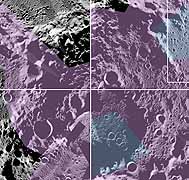 Efforts to find evidence of water on the moon came up dry, following the July 31 crash of the Lunar Prospector spacecraft into a deep crater in the southern lunar polar region University of Texas at Austin scientists announced Wednesday. But their research efforts have laid the groundwork for further investigations, as well as demonstrating a potentially useful new method for lunar prospecting.
The UT Austin group announced its findings at the annual meeting of the American Astronomical Society's Division for Planetary Sciences in Padua, Italy. In what was virtually a no-budget attempt to vaporize ice suspected to exist at the South Pole of the moon, NASA worked with engineers and astronomers at UT Austin to crash the space agency's successful Lunar Prospector spacecraft in a specific polar crater in a precise manner. The July 31 crash took only seconds. But the painstaking analysis of information recorded by more than a dozen professional Earth- and space-based telescopes required several months. Hundreds of amateur telescope owners also observed as the spacecraft plunged into a permanently shadowed crater near the pole. "As expected, we didn't make a big splash, or we all would have seen a water signal quickly," said Dr. David Goldstein, leader of the UT Austin team that proposed the crash. Goldstein, an aerospace engineer, is an associate professor in the UT Austin Department of Aerospace Engineering and Engineering Mechanics.
Last year, the Lunar Prospector team reported the spacecraft's instruments had revealed possible signs of frozen water at the moon's north and south poles. At that point, the UT Austin team came up with the idea of a controlled crash. "The way we aimed to detect water -- or its signature -- was through sensitive spectrometers tuned to look for the ultraviolet spectral emission lines expected from the hydroxyl (OH) molecules," said Barker. Barker and Shim analyzed the spectra from NASA's Hubble Space Telescope, McDonald telescope and the Keck I in Hawaii. Scientists and engineers working on the project knew from the beginning that there was a low probability of proving existence of water on the moon and the research discussed in Padua did not confirm water's existence. But the researchers said several benefits resulted from this potentially high-payoff experiment, including:
The team offered several possible reasons why the telescopic information has yielded no evidence of water, however, there is no way of knowing which of them might apply:
Email This Article Comment On This Article Related Links Space
 Yuri Plus 41bb
 Sydney - Apr 08, 2002
It's only a year since the world staged the inaugural Yuri's Night celebrations, but so much has changed on Earth, and in space. In 2001, we contemplated a world that had shed most of the tensions associated with the cold war, and watched as several nations assembled the world's first International Space Station. |
|
|

|
|
|
|
|
|
|
|
|
|
|
|
| The content herein, unless otherwise known to be public domain, are Copyright 1995-2006 - SpaceDaily.AFP and UPI Wire Stories are copyright Agence France-Presse and United Press International. ESA PortalReports are copyright European Space Agency. All NASA sourced material is public domain. Additionalcopyrights may apply in whole or part to other bona fide parties. Advertising does not imply endorsement,agreement or approval of any opinions, statements or information provided by SpaceDaily on any Web page published or hosted by SpaceDaily. Privacy Statement |

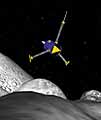 Prior to the crash, Goldstein worked to model and calculate the final orbit and crash of the Lunar Prospector with Dr. R. Steven Nerem, also an aerospace engineer and an associate professor in the department; aerospace engineering students J. Victor Austin and Jeong Yon Shim; and NASA engineers. Dr. Edwin S. Barker, research scientist with the UT Austin Department of Astronomy, coordinated worldwide observations of the crash.