|
 |
 |
 |
 |
 |
 |
 |
 |

 |
Probing The Upper Reaches of Earth's Atmosphere
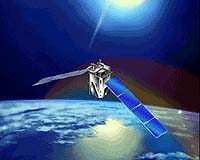
Boulder - Dec 12, 2001 The launch of a new research satellite December 7 is expected to provide scientists at the National Center for Atmospheric Research (NCAR) and other institutions with an unprecedented view of the mysterious upper regions of the earth's atmosphere. Improved knowledge of the region -- known as the mesosphere and lower thermosphere/ ionosphere -- could bolster communications networks, ensure that satellites stay on course, and provide scientists with greater insight into human influences on the atmosphere. NASA launched the satellite aboard a Delta II rocket from Vandenberg Air Force Base in California. TIMED (which stands for Thermosphere, Ionosphere, Mesosphere, Energetics and Dynamics) is designed to obtain a global picture of the portion of the atmosphere from about 40 to 110 miles (60-180 kilometers) above the earth's surface. This complex region, greatly influenced by the sun, is too high for ground-based instruments to probe in much detail. The TIMED satellite will provide the first comprehensive picture of temperature, wind, and chemical composition there. "We're looking at weather at the edge of space," says NCAR's Stanley Solomon, a principal investigator for TIMED. "This interface between the earth's atmosphere and space is an extraordinarily variable and dynamic region." With TIMED, Solomon believes that scientists will move to nowcasting the upper atmosphere -- that is, reporting with some accuracy on current conditions. In a few years, scientists may be able to provide one-hour forecasts of upper-atmosphere weather. "This part of the atmosphere is crucial to our understanding of the overall solar-terrestrial system," says NCAR director Tim Killeen, principal investigator for the TIMED Doppler Interferometer (TIDI), an instrument that will measure globally the speed and direction of high-atmosphere winds. "TIMED will for the first time thoroughly probe this region by exploring the full range of atmospheric parameters, allowing us to establish a pole-to-pole climatology." TIDI measurements will provide important information on such upper-atmosphere phenomena as gravity waves, airglow and auroral emission rates, noctilucent clouds, and ion drifts, besides basic information about high-level global winds and temperatures. The area that TIMED is exploring is profoundly affected by the sun's magnetic field and radiant energy. Yet it is the least-understood region of the atmosphere. Ground-based instruments can detect only a small portion of it, and sounding rockets provide just a brief picture of the region before falling back toward the earth. The TIMED spacecraft is designed for a 388-mile (625-kilometer) circular orbit around the earth. The spacecraft's four instruments will measure solar radiation, auroral energy inputs, temperature, pressure, key gases, and other characteristics of the upper atmosphere. The mesosphere and lower thermosphere/ionosphere is attracting the interest of scientists because of its important impacts on orbiting vehicles and communications systems. For example, when upper atmospheric temperatures rise, the resulting expansion pushes molecules to higher altitudes. This increased density exerts an added drag on satellites and slows down their orbits. Changes in the ionosphere can disrupt radio waves and affect the Global Positioning System (GPS). In addition, bursts of solar radiation can affect astronauts working on the space station. "We have a large investment in a space-based economy," says Solomon. "This drives our need for a better understanding of issues like the effects of atmospheric drag on orbits and the effects of the ionosphere on communications." The upper atmosphere may also provide a window into the impacts of human-generated emissions of methane, carbon dioxide, and other gases on the lower atmosphere -- some of which have been linked to global warming. "I'd like to understand the interaction of the energy input of the sun with the chemical composition and how that interaction controls the temperature and the wind vectors in the upper atmosphere," says NCAR's Anne Smith, a principal investigator analyzing measurements of ozone, hydrogen, and other key upper-atmosphere components. Knowledge of the upper atmosphere lags behind that of the lower atmosphere by many decades. Scientists lack the data to provide satellite operators with even the crudest of forecasts about winds, temperatures, and other conditions in the mesosphere and lower thermosphere/ionosphere. "Right now, it's similar to where we were 50 years ago when nobody believed the weather forecasts," Solomon explains. "With TIMED, we will make fundamental advances in understanding this region," he predicts. "The next step is to use the basic research to provide real societal benefits." Scientists in NCAR's High Altitude Observatory and Atmospheric Chemistry Division are playing key scientific roles. A number of federal agencies and universities are taking part in the mission. NCAR's primary sponsor is the National Science Foundation. More on TIMED http://www.timed.jhuapl.edu TIDI instrument aboard TIMED http://tidi.engin.umich.edu/main.html National Center for Atmospheric Research ucar.edu CommunityEmail This Article Comment On This Article Related Links SpaceDaily Search SpaceDaily Subscribe To SpaceDaily Express Dirt, rocks and all the stuff we stand on firmly
 Magnetic Reconnection Region Larger Than 2.5 Million Km Found In The Solar Wind
 Paris (ESA) Jan 12, 2006
Using the ESA Cluster spacecraft and the NASA Wind and ACE satellites, a team of American and European scientists have discovered the largest jets of particles created between the Earth and the Sun by magnetic reconnection. This result makes the cover of this week's issue of Nature. |
|
|

| The content herein, unless otherwise known to be public domain, are Copyright 1995-2006 - SpaceDaily.AFP and UPI Wire Stories are copyright Agence France-Presse and United Press International. ESA PortalReports are copyright European Space Agency. All NASA sourced material is public domain. Additionalcopyrights may apply in whole or part to other bona fide parties. Advertising does not imply endorsement,agreement or approval of any opinions, statements or information provided by SpaceDaily on any Web page published or hosted by SpaceDaily. Privacy Statement |