|
 |
 |
 |
 |
 |
 |
 |
 |

 |
Probing The Most Energetic Explosions In The Solar System
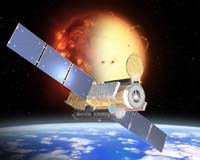
London UK (SPX) Sep 12, 2006 Solar flares are tremendous explosions on the surface of our Sun, releasing as much energy as a billion megatons of TNT in the form of radiation, high energy particles and magnetic fields. The Sun's magnetic fields are known to be an extremely important factor in producing the energy for flaring and when these magnetic fields lines clash together, dragging hot gas with them, an enormous maelstrom of energy is released. This boiling cauldron of plasma is ejected at huge speeds into the solar system and high energy particles, such as protons, can arrive at Earth within tens of minutes, to be followed a few days later by Coronal Mass Ejections, huge bubbles of gas threaded with magnetic field lines, which can cause major magnetic disturbances on Earth, sometimes with catastrophic results. Whilst scientists understand the flaring process very well they cannot predict when one of these enormous explosions will occur. The Solar-B mission, designed and built by teams in the UK, US and Japan, will investigate the so called 'trigger phase' of these events. "Solar flares are fast and furious - they can cause communication black-outs at Earth within 30 minutes of a flare erupting on the Sun's surface. It's imperative that we understand what triggers these events with the ultimate aim of being able to predict them with greater accuracy" said Prof. Louise Harra, the UK Solar-B project scientist based at University College London's Mullard Space Science Laboratory [UCL/MSSL]. Solar-B will measure the movement of magnetic fields and how the Sun's atmosphere responds to these movements. Since the Sun is constantly changing on small timescales Solar-B will be able to distinguish between steady movements and the changes that will build-up to a flare. The spacecraft will be launched on the 22nd September 22:00 UT from the Japan Aerospace Exploration Agency (JAXA) Uchinoura Space Centre at Uchinoura Kagoshima in southern Japan. Solar-B will be launched into a Sun-synchronous orbit allowing uninterrupted viewing. "The Sun behaves unpredictably and will be as likely to flare during spacecraft 'night' when Solar-B would be behind the Earth, which is why we have chosen a special type of polar orbit that will give us continuous coverage of the Sun for more than 9 months of the year," said Prof. Len Culhane from UCL/MSSL, Principal Investigator of the Extreme Ultraviolet Imaging Spectrometer [EIS] instrument on Solar-B. Solar-B carries three instruments which have been designed to explore the critical trigger phase of solar flares. The UK (UCL/MSSL) led EIS instrument, an extremely lightweight 3-metre long telescope, will measure the dynamical behaviour of the Sun's atmosphere to a higher accuracy than ever before, allowing measurement of small-scale changes occurring during the critical build-up to a flare. "In order to make the EIS as light as possible we used the same type of carbon fibre structure, from McClaren Composites, that is used to build racing cars, although being in space will subject the material to many more demands than the average racing car" said Dr Ady James, EIS Instrument Project Manager at UCL/MSSL. The EIS instrument is complemented by optical and X-ray telescopes and all three instruments will help solve the long-standing controversies on coronal heating and dynamics. "Solar-B will give us an increased understanding of the mechanisms which give rise to solar magnetic variability and how this variability modulates the total solar output and creates the driving force behind space weather," said Prof. Keith Mason, CEO of the Particle Physics and Astronomy Research Council [PPARC], the funding agency behind UK involvement in the spacecraft. Prof. Mason added, "Predicting the timing and strength of solar flares is critical if we want to mitigate the threat to orbiting spacecraft and Earth-based communication systems". Community Email This Article Comment On This Article Related Links Particle Physics and Astronomy Research Council Solar Science News at SpaceDaily
 National Lab Gets Zapped As Part Of Space Research
 Albuquerque NM (SPX) Sep 10, 2006
There was nothing to fear in the smoke billowing from atop a tall tower at Sandia National Laboratories. The bright, blazing light striking the 200-foot-high rooftop last week wasn't from an alien attack. |
|
|

| The content herein, unless otherwise known to be public domain, are Copyright 1995-2006 - SpaceDaily.AFP and UPI Wire Stories are copyright Agence France-Presse and United Press International. ESA PortalReports are copyright European Space Agency. All NASA sourced material is public domain. Additionalcopyrights may apply in whole or part to other bona fide parties. Advertising does not imply endorsement,agreement or approval of any opinions, statements or information provided by SpaceDaily on any Web page published or hosted by SpaceDaily. Privacy Statement |