|
 |
 |
 |
 |
 |
 |
 |
 |

 |
Proba Marks One Year On Orbit
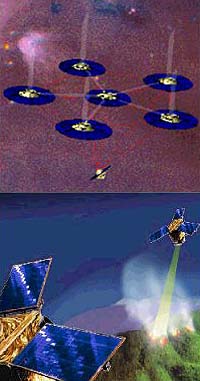
Paris (ESA) Oct 23, 2002 It is exactly one year today since the launch of ESA's first small autonomous spacecraft, Proba; a year in which Proba, and the instruments on board, have successfully carried out all the tasks they have been set. Frederic Teston, manager of the PROject for On-Board Autonomy which is better known as Proba, says "those responsible for Proba here at ESA are satisfied with the results so far, so much so that it has been decided to extend the mission for another year". Proba's main achievement is that this small spacecraft -- it is just 60x60x80 cm and looks as if it has been wrapped in blue and gold paper -- has shown that it is able to carry out many functions on its own. Its ability to carry out guidance, navigation, control, onboard scheduling and payload resources management by itself has significantly reduced the need for ground control. During its first year in orbit this small gyro-less spacecraft has proven that it is able to achieve a high accuracy in attitude determination by using autonomous star trackers. Onboard Proba the ERC-32 SPARC, which is the space version of a commercial high-speed processor, has performed flawlessly. The Li-ion batteries, used for the first time in a low-Earth orbit, have also performed according to specifications. But Proba is not just a pretty package, onboard it has six scientific instruments, all of which have performed successfully during the past 12 months with the minimum of intervention from ground control.
CHRIS
HRC
DEBIE
SREM All the goals that Proba was set have been achieved at a relatively low cost, thanks to the innovative approach used in its development. Extensive use was made of commercial off-the-shelf equipment and units, together with automated software generation and computer simulations for development, verification and testing. Community Email This Article Comment On This Article Related Links Proba ESTEC/Proba Unit Redu ground station ESA's space weather CHRIS instrument SREM instrument Proba Paper Model (PDF 176KB) SpaceDaily Search SpaceDaily Subscribe To SpaceDaily Express All about the robots on Earth and beyond!
 Engineers Deliver Robot to Neutralize Remote Explosives
 Tyndall AFB (SPX) Jun 30, 2005
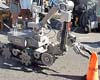
Engineers from the Air Force Research Laboratory Materials and Manufacturing Directorate have rapidly prototyped, developed, and delivered low-cost expendable robots to disable and dispose of improvised explosive devices. |
|
|

| The content herein, unless otherwise known to be public domain, are Copyright 1995-2006 - SpaceDaily.AFP and UPI Wire Stories are copyright Agence France-Presse and United Press International. ESA PortalReports are copyright European Space Agency. All NASA sourced material is public domain. Additionalcopyrights may apply in whole or part to other bona fide parties. Advertising does not imply endorsement,agreement or approval of any opinions, statements or information provided by SpaceDaily on any Web page published or hosted by SpaceDaily. Privacy Statement |