|
 |
 |
 |
 |
 |
 |
 |
 |

 |
Pristine Polar Lakes
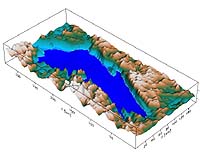
Moffett Field CA (SPX) Jul 14, 2004 Buried under more than two miles of ice, Lake Vostok is a freshwater basin that has remained isolated biologically from human influence. Recent air surveys now suggest that Vostok is actually two basins. If water doesn't flow between the two parts, different life forms may have evolved independently. Since establishing the Russian Vostok research station in 1957, sampling just above the freshwater basin has revealed microbes in the ice. The coldest temperature on Earth (-128.6 F) ever was recorded at Vostok on July 21, 1983. But the lake itself is not frozen and has been sealed for twenty million years from the rest of the biosphere. Larger than North America's largest lake (Lake Superior), estimates of water volume at Lake Vostok show that it has biologically sealed five percent of the world's total surface freshwater reserves. The unique opportunity to sample these polar lakes centers on their isolation from open air. As heat flows up from the Earth, melting ice keeps freshwater supplied as one of the last unexplored biological frontiers on the planet. "The ice covers of these lakes represent an oasis for life in an environment previously thought to be inhospitable," wrote John Priscu of Montana State University, who participated in a National Science Foundation project to investigate Antarctica lake covers. "These life forms may possess novel ice-active substances such as antifreezes and ice nucleation inhibitors that allow the organisms to survive the freeze-thaw cycles and come back to life when exposed to liquid water," he said. From taking ice cores, the scientists on the ground have found a layered chemical and biological history preserved in the ice, and revived viable microbes that are at least 2,800 years old. Importantly, the cold temperatures preserve DNA extremely well making them perfect 'ice museums' for the study of ancient DNA." An international team looking at sampling strategies may now consider drilling two holes to survey the twin sub-basins independently. One proposal for studying Vostok relies on autonomous submarines to cover the 140 mile long stretch of freshwater. While Lake Vostok is the largest, seventy-six freshwater, polar basins have been found under the Antarctic ice. Although Lake Vostok is off-limits for now there are indirect ways of seeing beneath the ice. Back in 1993 ERS data was employed to help map the Lake's full extent, establishing the ice directly over it was much flatter than that around it. More recently, German researchers have used ERS interferograms to establish that - despite their distance from the surface - the waters of Lake Vostok are stirred by daily tides. While discussing methods to study the lake's potentially novel biology, scientists have balked at contaminating the last virgin ecosphere. Drilling under the ice with sterile instruments would likely transfer microbes and contaminate probes during their two-mile ice penetration. Donna Shirley, former mission manager of the 1997 Mars Pathfinder, said, "at Lake Vostok , one of the big issues is, if we drill into it, our dirty drilling rigs are going to contaminate whatever's down there. " The process of looking for life may introduce life. This self-fulfilling prospect of contamination in an isolated ecosystem is akin to a biological form of the Heisenberg Uncertainty Principle: the act of observing alters what is to be observed. "The biological Heisenberg's Uncertainty Principle is, 'can we actually do the experiment?'", noted NASA's Planetary Protection Officer, John Rummel, when considering the Vostok sampling challenge as parallel to searching for life on other worlds. One step in resolving the dilemma is to apply as many non-contact probes as possible. The new findings on Lake Vostok was the first overall water depth map of the freshwater basin. Researchers from the Lamont-Doherty Earth Observatory of Columbia University and the University of Tokyo reported their findings in a recent issue of Geophysical Research Letters. Penetrating the two-mile ice cap with aircraft radar, a laser altimeter and gravity mapping first revealed the ridge. The water over the ridge they found is about 650 feet deep, compared to roughly 1,300 feet deep in the northern basin and 2,600 feet deep in the southern. The half-mile deep southern sub-basin is approximately double the spatial area of the smaller northern sub-basin. Completing the gravity survey required the equivalent of one hundred passes over Vostok, or over 10,000 air miles, to puzzle together the underwater map. Lake Vostok may resemble subsurface lakes thought to exist on Mars and on Europa, a moon of Jupiter. If sterile drilling techniques mature, their logistics may transfer to future mission plans for astrobiologists to evaluate. Community Email This Article Comment On This Article Related Links SpaceDaily Search SpaceDaily Subscribe To SpaceDaily Express Nuclear Space Technology at Space-Travel.com
 Rewriting Glacial History In Pacific North America
 Edmonton AB (SPX) Jan 10, 2006
Although the story on glacier fluctuations in northwestern North America over the last 10,000 years has remained largely unchanged for decades, new evidence discovered by a University of Alberta researcher will rewrite that glacial history and offer clues about our climate history during the last several thousand years. |
|
|

| The content herein, unless otherwise known to be public domain, are Copyright 1995-2006 - SpaceDaily.AFP and UPI Wire Stories are copyright Agence France-Presse and United Press International. ESA PortalReports are copyright European Space Agency. All NASA sourced material is public domain. Additionalcopyrights may apply in whole or part to other bona fide parties. Advertising does not imply endorsement,agreement or approval of any opinions, statements or information provided by SpaceDaily on any Web page published or hosted by SpaceDaily. Privacy Statement |