|
 |
 |
 |
 |
 |
 |
 |
 |

 |
Predicting The Climate Of The 21st Century
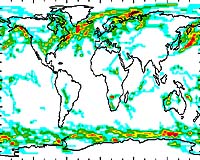
Boulder - Feb 25, 2003 Warming land and ocean surfaces, melting glaciers, rising sea levels, and other recent evidence strongly suggest that Earth's climate is already changing rapidly because of the buildup of greenhouse gases in the atmosphere, according to Warren Washington, senior scientist and head of the Climate Change Research Group at the National Center for Atmospheric Research (NCAR). Computer models of Earth's climate support these observations, he says, and indicate more severe changes yet to come. Even if societies successfully cap worldwide greenhouse gas emissions, the global climate will continue to warm into the 22nd century, though at a slower rate than if no attempt is made to control the emissions, Washington says. Policy makers must prepare to adapt to a changing climate even while slowing the greenhouse gas buildup, he says. Washington will present these conclusions in his talk, "Predicting the Climate of the 21st Century," at the annual meeting of the American Association for the Advancement of Science in Denver on February 16. "Scientific confidence in the ability of models to project future climate has increased," says Washington. "Meanwhile, recent experiments and routine monitoring have found evidence of global climate changes already occurring that are much larger than can be explained by the climate's natural variability." In his talk, Washington explained how a computer model of global climate works and highlight what the most sophisticated models in the United States and elsewhere are now telling us about present and future climate. A rise in the average global temperature is a convenient marker to indicate changes in actual climate extremes that affect our environment, says Washington. For example, heat waves, as well as floods and droughts, will become more severe and occur more often. The first freeze dates will arrive later, and hard freezes will become less frequent in some areas. Rainfall and snowfall will increase or decrease, depending on the region. The difference between daily high and low temperatures will shrink in many areas as average temperature rises. Such climate changes occurring around the globe are likely to affect disease and health patterns and threaten ecosystems, with important implications for forest survival, food supply, biodiversity, land use, and pollution. "We are already seeing many of these changes," says Washington. "The debate on whether climate change is occurring has ended. The question is how much will take place and what are its impacts." Community Email This Article Comment On This Article Related Links The University Corporation for Atmospheric Research SpaceDaily Search SpaceDaily Subscribe To SpaceDaily Express Dirt, rocks and all the stuff we stand on firmly
 Magnetic Reconnection Region Larger Than 2.5 Million Km Found In The Solar Wind
 Paris (ESA) Jan 12, 2006
Using the ESA Cluster spacecraft and the NASA Wind and ACE satellites, a team of American and European scientists have discovered the largest jets of particles created between the Earth and the Sun by magnetic reconnection. This result makes the cover of this week's issue of Nature. |
|
|

| The content herein, unless otherwise known to be public domain, are Copyright 1995-2006 - SpaceDaily.AFP and UPI Wire Stories are copyright Agence France-Presse and United Press International. ESA PortalReports are copyright European Space Agency. All NASA sourced material is public domain. Additionalcopyrights may apply in whole or part to other bona fide parties. Advertising does not imply endorsement,agreement or approval of any opinions, statements or information provided by SpaceDaily on any Web page published or hosted by SpaceDaily. Privacy Statement |