|
 |
 |
 |
 |
 |
 |
 |
 |

 |
Pratt and Whitney Demonstrates Lunar Mission Propulsion System
West Palm Beach FL (SPX) Jul 07, 2006 Pratt and Whitney Rocketdyne announced Thursday its Common Extensible Cryogenic Engine has exceeded performance goals and demonstrated propulsion technologies required to land spacecraft on the Moon. In a Phase I Development Program test, the CECE demonstrated an overall deep-throttling capability of 11.4 to 1, exceeding the test goal of 10 to 1. Deep throttling, or a wide variation of thrust, enables a vehicle to maintain adequate thrust during in-space travel, yet have a controlled descent at its final destination. The CECE has accumulated a total run time of 900 seconds during testing that began in April at PWR facilities in West Palm Beach. Review of preliminary test data indicates all primary and secondary test objectives were achieved. The CECE is a deep-throttling, 15,000-pound-thrust-class engine fueled by a mixture of liquid oxygen and liquid hydrogen. The engine will validate key component technologies required by high energy, in-space propulsion systems for future space exploration such as the Lunar Surface Access Module, the Crew Exploration Vehicle and in-space transfer systems. NASA awarded Pratt and Whitney Rocketdyne a $6 million contract in June 2005 to begin development of the Common Extensible Cryogenic Engine. The two-phase technology development program includes two separate design, manufacturing and engine system-level demonstration tests. The CECE is built upon Pratt and Whitney Rocketdyne's fundamental design of its RL10 cryogenic upper-stage engine, which currently is in production for service on the Atlas and Delta launch vehicles. "We are extremely pleased that the performance of the CECE clearly demonstrates the engine is fully capable of supporting NASA's lunar-landing objectives," said Graham Webb, PWR's general manager. "The CECE project has achieved an early success for NASA's exploration program by demonstrating that a cryogenic engine can be throttled over a wide thrust range, which may enable its use in a variety of mission applications," said Chris Moore, program executive for exploration technology at NASA Headquarters in Washington, D.C. "The collaborative efforts of Pratt and Whitney Rocketdyne, NASA Marshall Space Flight Center and NASA Glenn Research Center made it possible to begin engine system-level testing for deep-throttling technology advancement only 10 months after program start," said Victor Giuliano , PWR's CECE program manager. Community Email This Article Comment On This Article Related Links Pratt and Whitney Rocketdyne Mars News and Information at MarsDaily.com Lunar Dreams and more
 SMART 1 Photographs Kepler Crater Up Close
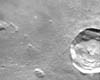 Paris, France (SPX) Jul 04, 2006
ESA's SMART-1 spacecraft took this image of Kepler crater on the Moon using its Advanced Moon Imaging Experiment. The AMIE obtained the image on Jan. 13 from a distance ranging between 1,613 kilometers and 1,702 kilometers (1,000 miles to 1,055 miles) from the surface, with a ground resolution between 146 meters and 154 meters (475 feet and 500 feet) per pixel. |
|
|

| The content herein, unless otherwise known to be public domain, are Copyright 1995-2006 - SpaceDaily.AFP and UPI Wire Stories are copyright Agence France-Presse and United Press International. ESA PortalReports are copyright European Space Agency. All NASA sourced material is public domain. Additionalcopyrights may apply in whole or part to other bona fide parties. Advertising does not imply endorsement,agreement or approval of any opinions, statements or information provided by SpaceDaily on any Web page published or hosted by SpaceDaily. Privacy Statement |