|
 |
 |
 |
 |
 |
 |
 |
 |

 |
Powell Ready To Discuss Russian Shield Proposals
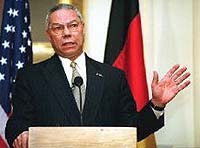
Washington (AFP) Feb. 21, 2001 US Secretary of State Colin Powell is willing to discuss Moscow's proposal for a European missile shield when he meets this weekend with Russian Foreign Minister Igor Ivanov, the State Department said Wednesday. However, spokesman Richard Boucher warned that while Powell is ready to talk about it when he and Ivanov meet face-to-face for the first time on Saturday in Cairo, the plan appeared incomplete and would require serious study before Washington could begin to consider it. "We need to study it in detail before we can make a realistic assessment of what Russia has in mind," Boucher told reporters. As a Pentagon spokesman did on Tuesday after Russian Defense Minister Igor Sergeyev delivered the plan to NATO Secretary General George Robertson, Boucher said the United States was pleased that Moscow appeared to realize the threat posed by so-called "rogue states" with ballistic missiles. "We welcome the fact that Russia recognizes that Europe faces a serious threat from weapons of mass destruction and missile delivery systems and that Russia believes that defensive systems are necessary for protection and stability," he said. "But we would also note that the deployment of missile defense for Europe would not protect the United States against ballistic missile launches and so it would not be a substitute for the deployment of a national missile defense," Boucher said. Moscow is vehemently opposed to US plans to develop and deploy a national missile defense (NMD) system, believing it to be a threat as well as a violation of the landmark 1972 Anti-Ballistic Missile (ABM) Treaty. In an apparent effort to soften its stance, though, Russia suggested an alternative which calls for a defensive system with mobile elements placed at points most threatened by missile attack. But the system would only be set up if Russia and the Europeans first agreed there was a threat and after talks aimed at dealing with the threat by political or peaceful means. Saturday's meeting between Powell and Ivanov will also likely focus on the Middle East, Iraq sanctions, bilateral ties including the arrest outside Washington this week of an FBI agent on charges of spying for Moscow and US concerns about civil liberties and human rights in Russia, Boucher said.
"Obviously, the meeting ... is the secretary's first chance to get together with him face to face, to discuss a broad variety of issues in our relationship," he said.
NATO chief promises fair hearing for Russian NMD counter-offer Completing a bridge-building mission, Robertson said he sensed a pivotal change in the Russian view on potential threats of attack from so-called rogue states, some of which are being courted by Moscow. However even Russian officials admitted they gave only a vague outline of their missile defense plan, while stressing that their proposals -- unlike Washington's national missile defense (NMD) -- abided by all existing nuclear defense agreement. "The 19 countries of the alliance will give serious consideration to the proposals made yesterday on ballistic missile defense by the Russian government," Robertson told an audience at Moscow's MGIMO foreign relations institute. "It represents, in many ways, a change in the Russian position because it suggests that there are threats ... that come from an area close up to Europe and Russia," the NATO secretary-general said before departing Moscow for Prague. Washington concedes that its NMD shield would breach the cornerstone 1972 ABM agreement but argues the threat from nations like North Korea and Iraq demand a re-think of global security. "The threats are (also) to the USA at the moment, and (now) there is a proposed military solution by the Russians to deal with these threats, to neutralize these threats," Robertson noted. However Robertson, who re-opened a Moscow NATO center that was shut in a Russian reprisal for allied bombing of Serbia during the 1999 Kosovo war, ruefully pointed out that Russia remained vehemently opposed to the Alliance's potential eastward expansion. "We take the Russian view seriously. But it is difficult to understand the nature of the Russian concerns. I do try, but I still don't understand. The alliance is no longer considered an adversary of Russia," he said. Moscow remains deeply distrustful of both NATO expansion and the NMD, which defense officials here fear could render Russia's shrinking nuclear stockpile useless within 10-15 years. In what Robertson conceded could be a "wedge-driving exercise," Russia on Tuesday handed th NATO chief a sketch of its own version of a European defense mechanism. It includes a joint appraisal of potential threats and use of mobile Russian S-300 rockets to intercept incoming missiles -- a system that would never cover all of Europe at all times. "Through the example of our proposals, we wanted to show that it is possible to reach a resolution which can confront threats but which would not violate the 1972 ABM treaty," said Russian Foreign Minister Igor Ivanov. Ivanov said Washington has showed a "constructive approach" to the Moscow proposal. Meanwhile Defense Minister Igor Sergeyev stressed that Russia has put long thought into its own defense system -- underlining Moscow's view that the US NMD was technologically unfeasible. "We have the military and scientific technology," said Sergeyev. "I think that if we consolidate our position with the Europeans, then I think we will be able to fulfill everything that we have proposed." He promised that Russian defense experts would shortly visit Brussels "to clarify (the Russian proposal), so that the whole world understood that our position is open and trustworthy." AFP correspondent Igor Gedilaghine contributed to this report All rights reserved. � 2001 Agence France-Presse. All information displayed on this section (dispatches, photographs, logos) are protected by intellectual property rights owned by Agence France-Presse. As a consequence, you may not copy, reproduce, modify, transmit, publish, display or in any way commercially exploit any of the content of this section without the prior written consent of Agence France-Presse. CommunityEmail This Article Comment On This Article Related Links SpaceDaily Search SpaceDaily Subscribe To SpaceDaily Express Military Space News at SpaceWar.com
 Canada To Seek International Pact Banning Weapons In Space
 Ottawa (AFP) Jan 11, 2006
Canadian Prime Minister Paul Martin will seek an international pact to ban weapons in space if his Liberals are returned to power in a January 23 election, according to the party platform. |
|
|

|
|
|
|
|
|
|
|
|
|
|
|
| The content herein, unless otherwise known to be public domain, are Copyright 1995-2006 - SpaceDaily.AFP and UPI Wire Stories are copyright Agence France-Presse and United Press International. ESA PortalReports are copyright European Space Agency. All NASA sourced material is public domain. Additionalcopyrights may apply in whole or part to other bona fide parties. Advertising does not imply endorsement,agreement or approval of any opinions, statements or information provided by SpaceDaily on any Web page published or hosted by SpaceDaily. Privacy Statement |