|
 |
 |
 |
 |
 |
 |
 |
 |

 |
The Topex/Poseidon Oceanography Mission Ends
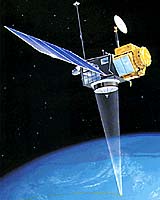
Pasadena CA (SPX) Jan 06, 2006 The joint NASA/Centre National d'Etudes Spatiales Topex/Poseidon oceanography satellite ceased operations after nearly 62,000 orbits of Earth. The spacecraft lost its ability to maneuver, bringing to a close a successful 13-year mission. "Topex/Poseidon revolutionized the study of Earth's oceans, providing the first continuous, global coverage of ocean surface topography and allowing us to see important week-to-week oceanic variations," said Dr. Mary Cleave, associate administrator for NASA's Science Mission Directorate. "Its data made a huge difference in our understanding of the oceans and their effect on global climatic conditions." Topex/Poseidon data have helped in hurricane and El Nino/La Nina forecasting, ocean and climate research, ship routing, offshore industries, fisheries management, marine mammals' research, modernizing global tide models and ocean debris tracking. "Topex/Poseidon was built to fly up to five years, but it became history's longest Earth-orbiting radar mission," said Topex/Poseidon Project Scientist Dr. Lee-Lueng Fu of NASA's Jet Propulsion Laboratory, Pasadena, Calif. "It provided, on average, more than 98 percent of the science data it was designed to collect in every 10-day measurement cycle, a remarkable achievement." The satellite's pitch reaction wheel, which helps keep the spacecraft in its proper orbital orientation, stalled on October 9, and ground controllers concluded the wheel was not functioning. The satellite remains in orbit 1,336 kilometers (830 miles) above the Earth, posing no threat to the planet. "Topex/Poseidon was a unique mission that attracted users around the world, including more than 600 scientists in 54 countries," said Dr. Yves Menard, Topex/Poseidon project scientist at Centre National d'Etudes Spatiales in Toulouse, France. Topex/Poseidon's data have been the subject of more than 2,100 research publications; major science and application achievements include: - the first decade-long global descriptions of seasonal and yearly ocean current changes - refined scientists' estimates of rising global sea level during the past decade - provided a new understanding of the role tides play in mixing the deep ocean - developed the most accurate ever global ocean tides' models - provided the first global data set to test ocean general circulation model performance - demonstrated global positioning system measurements in space could determine spacecraft positions with unprecedented accuracy, enabling rapid delivery of data. Jason, a follow-on oceanography mission launched in December 2001, is continuing Topex/Poseidon's study of ocean circulation affects on the Earth's climate. Jason precisely maps the surface height, wind speed and wave height of 95 percent of Earth's ice-free oceans every 10 days. The data provide invaluable input for short-term weather forecasting, long-term climate forecasting and prediction models. Topex/Poseidon's stellar performance allowed it to fly in tandem with Jason for nearly three years, doubling data collection. This allowed the study of smaller-scale ocean phenomena like coastal tides, ocean eddies and currents. It also improved understanding of how low-frequency ocean waves transmit signals of climate change. Beyond Jason, the Ocean Surface Topography Mission is in development for a scheduled launch in 2008. It will continue providing high-precision sea surface height data to the oceanographic science community. The joint effort had its genesis in 1979, when NASA began developing the Topex mission, while the Centre National d'Etudes Spatiales was planning a similar one called Poseidon. The agencies formed a single mission in 1983, and it was launched August 10, 1992. JPL manages the U.S. portion of Topex/Poseidon/Jason for NASA's Science Mission Directorate. Centre National d'Etudes Spatiales manages the French portion of both missions. Community Email This Article Comment On This Article Related Links Jason Centre National d'Etudes Spatiales SpaceDaily Search SpaceDaily Subscribe To SpaceDaily Express Earth Observation News - Suppiliers, Technology and Application
 NASA Eyes Mission Into The Birthplace Of Hurricanes
 Huntsville AL (SPX) Jun 27, 2005
NASA hurricane researchers are deploying to Costa Rica next month to investigate the birthplace of eastern Pacific tropical cyclones. They will be searching for clues that could lead to a greater understanding and better predictability of one of the world�s most significant weather events -- the hurricane. |
|
|

| The content herein, unless otherwise known to be public domain, are Copyright 1995-2006 - SpaceDaily.AFP and UPI Wire Stories are copyright Agence France-Presse and United Press International. ESA PortalReports are copyright European Space Agency. All NASA sourced material is public domain. Additionalcopyrights may apply in whole or part to other bona fide parties. Advertising does not imply endorsement,agreement or approval of any opinions, statements or information provided by SpaceDaily on any Web page published or hosted by SpaceDaily. Privacy Statement |