|
 |
 |
 |
 |
 |
 |
 |
 |

 |
Pollution Slowly Choking North Chinas Largest Lake To Death
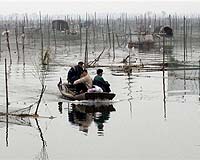
Anxin, China (AFP) May 01, 2006 When a slick of pollution in north China's biggest freshwater lake left fish farms decimated in early March, locals and environmentalists were little surprised. Large-scale fish deaths have occurred regularly since the 1980s as excessive amounts of untreated industrial waste water and raw sewage, coupled with drought and constantly falling water levels, have left Baiyangdian Lake in northern China's Hebei province choking for its life. "When we were kids we used to drink the water straight from the lake," Liu Zhanbing, 41, a fish farmer who has lived his entire life on the banks of the lake in Dazhangzhuang village, told AFP. "Now we can't even cook with it. We have to use well water for our drinking water." This year's fish kill came after upstream reservoirs of waste water in the Baoding city region, home to about 10 million people, emptied their putrid sludge into streams and rivers that run into the lake, state media said. The pollutants, full of phosphorous and nitrogen, sapped the oxygen out of the blackish green water and when the frozen lake thawed, farmers found their suffocated fish floating to the top. "Farmers who didn't harvest their fish in October, lost their entire crop," Liu said. "They were hoping that the fish would grow bigger over the winter and then they would be able to get better prices this spring." Liu, like many other farmers on the marshy lake, turned to fish farming after wild fish began dying out years ago. He said he barely makes ends meet farming fish, mostly carp, but there is no other work for him to do. With environmental disasters on the rise and especially following a huge toxic benzene spill on the Songhua river in northeast China in November, the government has repeatedly vowed to put an end to the environmental degradation that has come with 25 years of unbridled economic growth. For Chinese environmentalists and academics who have long called for more environmental protection, cleaning up Baiyangdian Lake has now become a test of China's determination to avoid an environmental crisis and clean up its act. So far, the government response has been strong with 218 polluting tannery, paper making and other factories above the lake shut down, while at least seven environmental protection officials in towns and cities up stream have been fired for allowing the waste water to be released into the lake. Upstream reservoirs which have hoarded natural run-off water for irrigation and industrial purposes have been ordered to share their water and open flood gates to help dilute the pollution in the lake. "We have been calling for these kinds of measures for over 10 years," Xu Muqi, director of the Research Center for Animal Ecology And Conservation at the prestigious Chinese Academy of Sciences, told AFP. "Baiyangdian, like so many other major Chinese lakes, has been dying a slow death for years. "The reasons are many. Too many people are competing for scarce water resources, not enough waste water is being treated and global warming has left north China in a drought since 1998."
-- Clean-up plan --
Situated just 130 kilometers (78 miles) south of Beijing, the marshy Baiyangdian Lake when full has a surface area of about 360 square kilometers and has historically provided north China with fresh water and biodiversity. Known as "the pearl of the north" it was central to the ecologoical system of the North China Plain, one of China's main breadbaskets, and once boasted a vast array of wildlife and wetland vegetation. A 1995 study co-authored by Xu found that most rivers and streams that ran into the lake had run dry due to upstream reservoirs holding back water, while pollution had killed off dozens of species of wild fish and other aquatic life. It also said the lake had lost its ability to clean itself because of the drastically reduced water inflows. "We recommended many urgent measures and called for all upstream cities and towns to treat their industrial water and sewage before allowing it to enter the lake," Xu said of the study. "We recommended that the 200,000 people living on the banks of the lake be relocated, especially the fish farmers who are also major polluters, and for the upstream reservoirs to end the hoarding of water." Fish farms produce a lot of organic pollution from fish excrement and excess food that falls to the bottom below the nets which cause algae blooms which sap the water of oxygen. Xu conceded the study's proposal was expensive and, due to the number of people vying for water resources, complicated. But since then a few water treatment plants had been built, he said, but little else done. However in August last year, the Baoding city government, which administers the lake, tabled a 15-year, 8.5 billion yuan (1.06 billion dollar) plan to clean up the lake and is presently awaiting the Asian Development Bank to approve a 96 million dollar loan to kickstart the effort. However, it is not clear where the other funds will come from. Fish farmers on the lake remain skeptical, saying the government has talked about cleaning up the lake for far too long, but the situation has only worsened. "We have heard the government say they are going to clean up Baiyangdian for years," said Ma Laoban, who oversees a dozen workers on a fish farm in Heyedian. "They say that when they get the money they are going to close down our fish farms and relocate us. They registered us for relocation years ago. "But it's a lot of talk. And as long as they keep talking, we will keep farming our fish. We can't do anything else."
Source: Agence France-Presse Community Email This Article Comment On This Article Related Links - Our Polluted World and Cleaning It Up
 50 Years On Echoes Of Tragic Past Haunt Japans Minamata City
 Minamata, Japan (AFP) May 01, 2006
First cats began to die. Then dead fish floated to the surface of the sea and crows fell lifeless to the ground. But still the people of Minamata had no idea what was about to happen to them. |
|
|

| The content herein, unless otherwise known to be public domain, are Copyright 1995-2006 - SpaceDaily.AFP and UPI Wire Stories are copyright Agence France-Presse and United Press International. ESA PortalReports are copyright European Space Agency. All NASA sourced material is public domain. Additionalcopyrights may apply in whole or part to other bona fide parties. Advertising does not imply endorsement,agreement or approval of any opinions, statements or information provided by SpaceDaily on any Web page published or hosted by SpaceDaily. Privacy Statement |