|
 |
 |
 |
 |
 |
 |
 |
 |

 |
Politics & Policies: Syria's fading spring
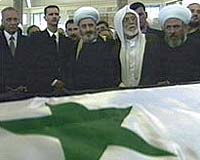
Washington (UPI) Oct 28, 2005 Syrian President Bashar Assad is likely to face growing scrutiny from the international community with Syria having sanctions imposed on it as a result of its implication in the assassination of former Lebanese Prime Minister Rafik Hariri unless it cooperates. It would be interesting to look back to see how the young leader who came to power in June 2000 upon the death of his father, Hafez, did so with so much promise for political reform and social change that there was talk of a "Damascus Spring." Alas, that Syrian spring never fully materialized and Damascus went straight to a bleak Syrian winter, which now lingers. "Bashar was a disappointment to many people," said Ammar Abdulhamid, a visiting fellow at the Brookings Institution's Saban Center for Middle East Policy. A disappointment? Yes, because Bashar found himself facing a dilemma: Introduce complete change in the Syrian political landscape or maintain the status quo. Change would have meant "giving up the people around him" and cutting ties with the old guard, his father's associates who ran the country with an iron fist for 30 years. Change would have meant the disentanglement of the clan-like infrastructure that has been so vital in keeping the Alawites and the Assad family in power for three decades. The regime in Damascus is structured "like the 'Godfather,' like the Corleone family," said Martin Indyk, director of the Saban Center. "Hafez was the Godfather and Basel (Sonny), should have taken over from his father." But in real life, as in the movie, Basel dies and the job goes to Bashar (Michael). Change would have meant the Alawites losing their power base. So Bashar chose the status quo instead -- or rather he was convinced it was the better of the two options: He chose to keep the old guard, reneged on any real changes he had promised to make and eventually became his father. At least he tried to. Bashar's laissez-faire led to an atmosphere of general disenchantment. For the first time, such diverse political groups as the Communist Party and the Muslim Brotherhood have come together to protest the continuing Baath Party rule. However, divisions between religious sects -- mostly Alawites and the Sunnis -- became more prominent. Then came the assassination of former Lebanese Prime Minister Rafik Hariri, closely followed by the popular uprising in Lebanon that was a reaction to the killing. This was followed by unprecedented international pressure on Syria, forcing Damascus to withdraw its forces and intelligence units from Lebanon. Then came the crux -- the report of the investigation by the United Nations' relentless German prosecutor Detlev Mehlis. The report not only pointed fingers at Syria, but named names. And not just any names. The Mehlis report mentions, among others, two of the three most powerful men in Syria: Maher Assad, the brother of the Syrian president who commands the Republican Guard, the praetorian bodyguard regiment that protects the ruling elite and their families. Flint Leverett, a senior fellow at the Saban Center, calls Maher "a real thug" and "a problem for Bashar." The second name is Ezat Shawkat, the president's brother-in-law who commands the Syrian intelligence service. Shawkat is married to Bashar's sister, Bushra. "Together they make a powerful couple," said Leverett. "And they are a long-term problem for Bashar." "The Mehlis report crystallized the divide," (in Syrian society), said Abdulhamid, the visiting Syrian fellow. "We are afraid of an Iraqi-type scenario." He explained that sectarian clashes such as the ones tearing Iraq apart, threaten Syria, too. Leverett takes a different approach. He says Bashar might be prepared to give up those he needs to in order to survive. Except, of course, those closest to him. However, if the president's brother and his brother-in-law were summoned before an international tribunal and fail to appear, sanctions are most certainly going to be imposed. While sanctions may hurt Syria, as they did Iraq, they will spare Bashar and his entourage, as they spared Saddam Hussein and his family. Syria may well hold out five or even 10 years, biding its way through the hardships, which will even give it a renewed sense of leadership in the Arab world. The trouble is, as Leverett explained, "the United States cannot afford to wait 10 years for sanctions to work." The best way for the United States to ensure its interests in the Middle East are met, believes Leverett, "is to help Bashar find a way out." And that may not be so simple. Community Email This Article Comment On This Article Related Links SpaceDaily Search SpaceDaily Subscribe To SpaceDaily Express The Long War - Doctrine and Application
 Bush Tries To Save Patriot Act
 Washington (UPI) Dec 19, 2005
It has been a weekend of unprecedented reactive political activity - it might even occur to some to call it panic - by the White House. |
|
|

| The content herein, unless otherwise known to be public domain, are Copyright 1995-2006 - SpaceDaily.AFP and UPI Wire Stories are copyright Agence France-Presse and United Press International. ESA PortalReports are copyright European Space Agency. All NASA sourced material is public domain. Additionalcopyrights may apply in whole or part to other bona fide parties. Advertising does not imply endorsement,agreement or approval of any opinions, statements or information provided by SpaceDaily on any Web page published or hosted by SpaceDaily. Privacy Statement |