|
 |
 |
 |
 |
 |
 |
 |
 |

 |
Politics & Policies: Syria Under Pressure
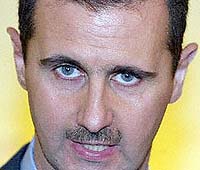
Washington (UPI) Oct 20, 2005 The Bush administration is taking new diplomatic steps against Syria, Secretary of State Condoleezza Rice told the Senate Foreign Relations Committee in Washington on Wednesday, indicating that regime change was not out of the question. Rice said the United States was using diplomacy to urge change in Syria's behavior, but did not rule out military force. "I'm not going to get into what the president's options might be," Rice said. "I don't think the president ever takes any of his options off the table concerning anything to do with military force." White House spokesman Scott McClellan said Syria was "trending in the wrong direction from the rest of the Middle East." Earlier this month, Newsweek magazine reported the U.S. government had discussed a possible military intervention in Syria. According to the article, Rice convinced her colleagues in the administration to await the release of Detlev Mehlis' report on his investigation into the assassination of former Lebanese Prime Minister Rafik Hariri before making a decision. This was confirmed to United Press International by Western diplomatic sources who say they convinced the Bush administration to at least wait until the Mehlis report was published and its results were made known. The goal seems to be to "get (the regime) by the throat, and then really squeeze," Joshua Landis, a Fulbright scholar in Damascus who runs an influential Web log, or online diary, called Syriacomment.com, told Newsweek. Between the apparent suicide of Syrian Interior Minister Ghazi Kenaan and pending the publication of the Mehlis report, analysts are asking just how stable is Bashar Assad's regime? Some believe Bashar is walking a tightrope without a safety net. Indeed, after decades of relative political stability, never has the mood in Syria been so fraught with incertitude, say several observers who recently visited the Syrian capital. In a country where events traditionally moved at a snail's pace, where time almost stood still during the 30 years of Hafez Assad's rule, events have suddenly shifted into warp speed. Hariri's assassination on Feb. 14 jolted Lebanon's silent majority out of their years of political stupor, driving them to the streets en masse, demanding the withdrawal of Syrian forces. With the tacit support of France and United States, the Cedar Revolution coerced Syria to pull its military and intelligence units out of Lebanon after almost three decades of occupation. The pace suddenly picked up. Syrian troops withdrew and Damascus reported that it also pulled out its intelligence units. Then came the investigation into Hariri's killing by Mehlis, the unrelenting German U.N. investigator -- the Elliott Ness of the Middle East -- whose mission in Beirut and Damascus raised a political storm and left a climate of uncertainty as to what may come next. Mehlis and his team of "Untouchables" questioned several high-ranking Syrian officials, including Roustom Ghazale, the former head of Syrian military intelligence in Lebanon, and Asef Shawkat, the current security chief in Damascus who is also the Syrian president's brother-in-law. Mehlis questioned six more high-ranking Syrian intelligence officials, according to the German magazine Stern. The Mehlis report also led to the arrest of four top Lebanese security officials. In June, Mehlis' team had searched the office and private apartment of Mustafa Hamdan, the pro-Syrian head of the Lebanese presidential guard. Hamdan is accused of messing with evidence at the scene of the crime, having ordered the crater left by the bomb to be filled in, Stern reported. Prosecutors arrested three more Lebanese officials, including Jamil Sayyed, the country's former security chief. Then came the apparent suicide of Syria's Kenaan, though informed sources have told UPI that Kenaan did not commit suicide but was killed by someone very close to the Syrian president. This information, of course, could not be independently confirmed. At the same time, pressure on Damascus from Washington is mounting more than ever before. Western diplomatic sources told UPI the Bush administration wants Damascus to: a) Secure its border with Iraq to prevent jihadi fighters entering Iraq to help the insurgency. b) Stop interfering in Lebanon. c) Force the groups Washington considers as terrorist organizations to close their offices in Damascus. (One possibility is that they may relocate to Gaza.) d) Establish diplomatic relations with Lebanon; something Syria has resisted until now claiming the two countries are too close to require the exchange of diplomatic missions. Meanwhile, a key part of the U.N. investigation focused on the Lebanese and Syrian mobile phone networks, and call records in the days preceding Hariri's death. In late September, the Lebanese police raided the offices of mobile phone company MTC Touch. In Damascus, the investigators demanded data from Syriatel and Spacetel, the country's two mobile phone operators. What the investigators found was that the requested information was provided with the notable exception of data relating to one particular transmission station serving Lebanon. Given those circumstances, commentators have speculated that Kenaan might have been killed as a sacrificial lamb to enable the regime to shirk responsibility for Hariri's killing, by portraying Kenaan as a loose cannon who had acted alone. It is widely expected that the U.N. report will implicate Syria's intelligence apparatus in Hariri's death. This is raising fears in Damascus that the United States will use the report as justification for direct military intervention. Community Email This Article Comment On This Article Related Links SpaceDaily Search SpaceDaily Subscribe To SpaceDaily Express The Long War - Doctrine and Application
 Bush Tries To Save Patriot Act
 Washington (UPI) Dec 19, 2005
It has been a weekend of unprecedented reactive political activity - it might even occur to some to call it panic - by the White House. |
|
|

| The content herein, unless otherwise known to be public domain, are Copyright 1995-2006 - SpaceDaily.AFP and UPI Wire Stories are copyright Agence France-Presse and United Press International. ESA PortalReports are copyright European Space Agency. All NASA sourced material is public domain. Additionalcopyrights may apply in whole or part to other bona fide parties. Advertising does not imply endorsement,agreement or approval of any opinions, statements or information provided by SpaceDaily on any Web page published or hosted by SpaceDaily. Privacy Statement |