|
 |
 |
 |
 |
 |
 |
 |
 |

 |
Politics & Policies: Gadhafi's Democracy
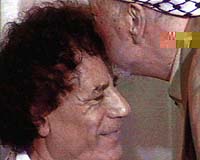
Washington (UPI) Aug 24, 2005 As part of efforts to bring about democracy and freedom to the more restrictive countries of the Arab world, the Bush administration is cozying up to Libyan strongman Moammar Gadhafi after he reneged on terrorism and gave up trying to acquire weapons of mass destruction. Gadhafi, the one-time blackest of sheep among Middle East potentates, has suddenly turned a lighter shade of gray. With that in mind Sen. Richard Lugar, R-Ind., the chairman of the Senate Foreign Relations Committee, headed to Libya this week hoping to push forward diplomatic relations with Tripoli, relations Libya would like to see expanded into full-blown ambassadorial exchanges. Lugar's trip will be the highest-profile U.S. visit to Libya. It follows earlier visits by officials from the Treasury and State Departments. However, exchanges of ambassadors may still be off the books for a while as Gadhafi still needs to introduce real changes in Libya. For decades Gadhafi has taunted the United States and the West by his blatant support of terrorist groups, funding of extremist Palestinian factions and arming of the Irish Republican Army, as well as providing support to a number of European separatist organizations such as the Corsicans, Basques and others. For nearly 30 years Gadhafi arrested, jailed and executed - often without trial - tens of hundreds of Libyans opposed to his authoritarian demagoguery. Gadhafi never hesitated to order his special branch of trained assassins to eliminate dissidents around the world or to place bombs in German discotheques frequented by American servicemen. He had a French civilian airplane blown out of the sky over Africa when he disagreed with Paris and was blamed for the bombing of PanAm flight 103 over Lockerbie, Scotland, to spite Washington. Gadhafi tried to acquire weapons of mass destructions only to later realize he would never have the capability of delivering them. In his own words, the supreme leader of the Libyan revolution said if Libya ever managed to construct or acquire a nuclear bomb, the only target they could probably hit would be the island of Malta. And to what avail? So why is it that this same Gadhafi decided to change his ways? Or has he? Critics of the Libyan regime argue that in truth nothing in Tripoli has changed. Astute as ever, the Libyan leader handed to a visiting U.S. congressional delegation some nuclear-bomb-making equipment, along with a promise to introduce political changes and democracy. But can Gadhafi who has ignored the law and ruled Libya through whims and caprices since he overthrew the monarchy in 1969 truly introduce democracy? Mahmoud Chamam, a Libyan journalist living in the United States, said on Al Hurra TV Monday arrests and executions were still common practice in Libya and that nothing had changed. Chamam and other Libyan exiles reject Gadhafi's "reforms" as pure whitewash meant to placate the Bush administration and to win him prestige and legitimacy in the eyes of the world and of his own people. Gadhafi even extended an invitation to President Bush to visit Libya. That would be the ultimate reward. Contented that the Libyan leader is talking of reform the administration has engaged him in dialogue, hoping to normalize relations with the North African nation, but along the way somehow continued to ignore his human rights abuses. It is precisely this attitude that has long angered critics of U.S. foreign policy who accuse Washington of consistently supporting corrupt regimes when it suits its interests. At this point it is worth asking what led Gadhafi to change his policy? According to several Libyan exiles, one of his sons, Saif al-Islam, is more business-oriented than his father. Saif and his business associates would like to acquire concessions of mega-American corporations, such as MacDonalds, Pizza Hut and Nike. But as long as Libya remains on the U.S. Department of State terror list, conducting business with U.S. companies remains impossible. So Saif convinces daddy that building WMD and supporting terrorism is bad for business. Well, you get the drift. Changes are announced to the outside world while internally the regime continues to detain political prisoners, to muzzle the press and to ban political parties. Saif meanwhile, who holds no official position in the Libyan government, invited Libyan expatriates to return and invest in Libya's future. If Libyans failed to flock back taking Gadhafi at his word, Western leaders wasted little time jostling for positions and prospective business deals. In this respect, Bush is not alone in flirting with Gadhafi and his potentially lucrative oil fields. Other top Western officials who have already visited Libya include Canadian Prime Minister Paul Martin, British Prime Minister Tony Blair, German Chancellor Gerhard Schroeder, French President Jacques Chirac and Italian Prime Minister Silvio Berlusconi. The list of foreign visitors looks impressive, but Libyan dissidents say they would like to see real changes. Community Email This Article Comment On This Article Related Links SpaceDaily Search SpaceDaily Subscribe To SpaceDaily Express Dirt, rocks and all the stuff we stand on firmly
 Magnetic Reconnection Region Larger Than 2.5 Million Km Found In The Solar Wind
 Paris (ESA) Jan 12, 2006
Using the ESA Cluster spacecraft and the NASA Wind and ACE satellites, a team of American and European scientists have discovered the largest jets of particles created between the Earth and the Sun by magnetic reconnection. This result makes the cover of this week's issue of Nature. |
|
|

| The content herein, unless otherwise known to be public domain, are Copyright 1995-2006 - SpaceDaily.AFP and UPI Wire Stories are copyright Agence France-Presse and United Press International. ESA PortalReports are copyright European Space Agency. All NASA sourced material is public domain. Additionalcopyrights may apply in whole or part to other bona fide parties. Advertising does not imply endorsement,agreement or approval of any opinions, statements or information provided by SpaceDaily on any Web page published or hosted by SpaceDaily. Privacy Statement |