|
 |
 |
 |
 |
 |
 |
 |
 |

 |
Politics & Policies: A Changing Mideast
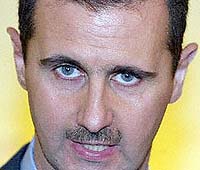
Washington (UPI) Nov 02, 2005 The Bush administration is putting unprecedented pressure on Syria to introduce political and social change at the same time growing opposition in Syria is doing the same. In a document released last month, the country's opposition defined the regime as holding a "monopoly of everything for more than 30 years," resulting in "an authoritarian, totalitarian, and cliquish regime that has led to a lack of politics in society." In the aftermath of the assassination of Lebanon's former Prime Minister Rafiq Hariri in February, and the release of the report by the U.N. investigator Detlev Mehlis into that killing, Damascus finds it is being pressed even more with Britain and France jumping into the fray. Additionally, Bashar Assad's regime is facing demands from a homegrown opposition that has come together in calling for changes despite its distinctive political differences. Groups as diverse as communists and the Muslim Brotherhood temporarily set aside on Oct. 16 their philosophical differences and joined forces with the publication of the "Damascus Declaration for Democratic National Change." Among the Declaration's many points (translated into English by Syriacomment.com), it says: "Syria today is being subjected to pressure it had not experienced before as a result of the policies pursued by the regime. ... Today Syria stands at a crossroad and needs to engage in self-appraisal and benefit from its historical experience more than any time in the past." The Syrian opposition blames the regime for its "short-sighted policies on the Arab and regional levels, and especially in Lebanon." It demands immediate steps be taken to rectify the situation. Among them: - The establishment of a democratic national regime based on dialogue and recognition of the other. - Shunning totalitarian thought and ... shunning violence in exercising political action; and seeking to prevent and avoid violence in any form and by any side. - Islam - which is the religion and ideology of the majority, with its lofty intentions, higher values and tolerant canon law -- is the more prominent cultural component in the life of the nation and the people. - No party or trend has the right to claim an exceptional role. No one has the right to shun the other, persecute him, and usurp his right to existence, free expression, and participation in the homeland. - Adoption of democracy as a modern system that has universal values and bases, based on the principles of liberty, sovereignty of the people, a state of institutions, and the transfer of power through free and periodic elections that enable the people to hold those in power accountable and change them. - Guarantee the freedom of individuals, groups and national minorities to express themselves, and safeguard their role and cultural and linguistic rights, with the state respecting and caring for those rights, within the framework of the Constitution and under the law. - Find a just democratic solution to the Kurdish issue in Syria, in a manner that guarantees the complete equality of Syrian Kurdish citizens with the other citizens, with regard to nationality rights, culture, learning the national language, and the other constitutional, political, social, and legal rights on the basis of the unity of the Syrian land and people. - Strengthen the national army and maintain its professional spirit, and keep it outside the framework of political conflict and the democratic game, and confine its task to protecting the country's independence, safeguarding the constitutional system, and defending the homeland and the people. The Damascus Declaration, if even portions of it were to be adopted, would revolutionize Syrian society, as we know it today. However, recent history has shown that Assad has been either unable or unwilling to implement change. The question now is what would happen if Syria fails to implement changes? The reply is in two parts. First, if Syria ignores external and internal pressures, sticking with the status quo, the danger exists it could lead to sectarian strife, say some analysts. Yet, this is all speculation given that few people really seem to know what is going on in Syria. It is "extremely difficult to know exactly what is going on in that country," Patrick Clawson, deputy director at the Washington Institute for Near East Policy told United Press International. "We have not seen the possibility of an alternative leadership in Syria," Clawson said, adding, there was no "clear sense of what the alternative power" might be for Syria. "We are profoundly ignorant of what is really going on in Syria," stated Clawson. Yet "the alternative of having (Assad) stay in power looks worse." The second possibility is that Assad would continue to shun changes and eventually Syria could implode -- much like Iraq. Under that scenario, we would see the creation of separate Sunni state, a fact that would please Iraq's Sunnis, who would find a natural ally. Similarly, Syria's Kurds could opt to join their Iraqi brethren in realizing a long-held Kurdish dream of creating a truly independent state. If that were to happen, keep your eye on Turkey. They have not said their final word on the Kurdish issue. Community Email This Article Comment On This Article Related Links SpaceDaily Search SpaceDaily Subscribe To SpaceDaily Express The Long War - Doctrine and Application
 Bush Tries To Save Patriot Act
 Washington (UPI) Dec 19, 2005
It has been a weekend of unprecedented reactive political activity - it might even occur to some to call it panic - by the White House. |
|
|

| The content herein, unless otherwise known to be public domain, are Copyright 1995-2006 - SpaceDaily.AFP and UPI Wire Stories are copyright Agence France-Presse and United Press International. ESA PortalReports are copyright European Space Agency. All NASA sourced material is public domain. Additionalcopyrights may apply in whole or part to other bona fide parties. Advertising does not imply endorsement,agreement or approval of any opinions, statements or information provided by SpaceDaily on any Web page published or hosted by SpaceDaily. Privacy Statement |