|
 |
 |
 |
 |
 |
 |
 |
 |

 |
PoliSci: Government Slow On RFID Privacy
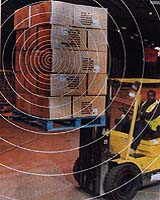
Washington DC (UPI) Oct 11, 2004 Depending on who you talk to, they will be sinister micro-spies, whose web of whispers will snare personal information with Orwellian efficiency. Or they will be dependable sentinels, shielding U.S. cities from infiltration by psychopathic terrorists. Or they will be tireless helpmates wordlessly working through the night to be sure your cat is healthy, your refrigerator is stocked and your coffee is ready just as you step out of the shower - even if you hit the snooze alarm, twice. They are Radio Frequency Identification Devices or RFIDs. A billion of them will be distributed in the next 14 months with billions more scattered across the globe over the next decade. Experts agree they can be used to track and monitor people. Commercial firms are worried privacy fears will kill the nascent industry. The question is whether anyone will address the privacy implications of RFID tags before they are inextricably mixed into our lives. RFID tags are tiny computer chips, each with its own antenna. Smaller than a grain of rice, they contain at a minimum a unique identification number that can be read from a distance by machine. Many tags can be read at once and new advances are expected to enable the reader to store new information on the chip. The signals are at frequencies that can pass through many materials so readers can see the tags through boxes and containers. If you carry an RFID-laced card in your wallet, perhaps a student ID or a building access card, there is a fairly good chance a reader can grab the ID number from that, too, even if it still is in your pocket. Some new tags have sensors. They could be used to monitor the health of livestock or pets by tracking their temperature. More advanced tags are on the horizon that will not need to be near a reader like the unpowered ones today. This new generation of tags will have their own batteries, more memory, and will be able to communicate with each other, passing messages along until they reach their destination. The day may come when the RFID tag on the milk carton reports it is no longer fresh and sends a message to the store to deliver a new carton. Today's tags, however, are used primarily to track shipments. RFID tags are gradually enabling businesses to scan entire shipments of goods in minutes and enter the items into inventory without unpacking pallets or tying up employee time. Wal-Mart, the world's most powerful retailer, has mandated its top 100 suppliers adopt the technology effective this January. Other retailers, struggling to shave costs, are following suit. Such shipping tags, perhaps with the addition of a sensor, could be used effectively to track shipping containers, experts told United Press International. Tens of thousands of such containers enter the United States every year and homeland security officials are worried they may be used to smuggle terrorist weapons. Such tags could be used to monitor containers starting at their place of origin and send out a warning if someone has tampered with the seal. RFID applications are concentrated on shipping because tags are too expensive to be placed on individual items. As the price for a tag drops, however, tags are expected to replace the familiar stripes of bar codes. At that point, it will be possible to capture expansive arrays of buying information about a person. RFID also will enable tracking of people's movements. Though it will be many years before constant tracking over extended distances is possible, it is not difficult to visualize a mall or large grocery chain placing RFID chips in their frequent-buyer cards and tracking people throughout the store to see how they shop. We see more than 50 bar-coded objects before we get to work ever day ... they are so pervasive they are almost invisible. Someday RFID tags will get there, said Ravi Pappu, founder of ThingMagic and an RFID expert. Pappu spoke before a workshop on RFID held by the Federal Communications Commission in Washington last Thursday. "The downside ... when you start tagging everything, is if you have tagged objects you can be tracked. There is a risk of that. But the interesting thing about this time ... is that (RFID) is not yet widely deployed enough, or low cost enough, to be incorporated in everyday objects. I think now is the right time to have a very serious debate about the privacy issues because this will become a problem if it is not dealt with, Pappu said. Now is the time to exercise all possible options in the evolution of this technology. At least a half-dozen other technical experts speaking at a meeting brought up the importance of privacy measures. Privacy is the most important thing we can do, said Sue Hutchinson, director of product management at EPCglobal, an RFID standard-setting organization. Members of the workshop panel requested the FCC make regulatory changes that would have significant privacy implications without suggesting or acknowledging changes that might be needed to protect a person's right to be left alone. Multispectural Solutions Inc. of Germantown, Md., wanted changes to enable RFID tags based on Ultra-Wide Band, an approach to sending radio signals akin to a series of pings instead of changes in frequency. The new technology at the frequencies requested would enable the reading of RFID tags from as far away as 600 feet, instead of the current 15 to 30 feet. The tags also could be read through metal, a problem for today's limited readers. Other firms asked to be allowed to use more power in their readers and for help in setting additional common standards. If the FCC agrees to these requests, it would enable tag readers to gather information from a greater distance with better accuracy. The FCC, however, did not appear interested in taking up privacy as an issue. It did not have a privacy expert on the all-day workshop panel. When Ed Thomas, head of the workshop panel and chief of FCC's Office of Engineering and Technology summarized points the FCC needed to consider for action, privacy was not on the list. Across the country, a different commission also appears headed toward a no-action decision on privacy. The Federal Trade Commission held an information-gathering meeting in July and is in the process of preparing a report. Chuck Harwood, regional director for the FTC in Seattle, where the RFID meeting was organized, said there was little evidence so far of the sort of unfair practices that normally spurred the FTC into action. RFID is down the road far enough that we don't have much of a record in terms of deception and unfair practice, Harwood told UPI. One of the considerations for any rulemaking would be the prevalence of unfair acts and practices. It's not essential but that is a consideration we typically take into account in the rulemaking. Even if there were an identified issue, it is not clear the FTC would take an active role. Most of our recent rulemakings have been at the direction of Congress, not our own initiative, Harwood said. I don't think we've written our own rule for 10 years at least. The FTC may get that directive. Rep. Jerry Kleczka, D-Wis., proposed legislation mandating consumers be notified if an item has an RFID tag and given the option of removing or permanently disabling it at purchase. A spokesman for Kleczka said he proposed the bill after a constituent expressed concern about RFID tagging. The bill, H.R. 4673, still is in committee, however. Considering the crush of year-end legislation, and the abbreviated congressional schedule due to the election, it is unlikely it will be passed this year. If it does not pass this year, Sen. Bill Nelson, D-Fla., might propose something similar. Nelson told UPI he has been waiting for the FTC report before deciding what to do. I am hopeful that what they're going to do is to come out with some protection of privacy. Nelson said. If they do, the legislation would not be needed. Nelson told UPI he would absolutely consider legislation if the FTC fails to act. In the mean time, the numbers of tags are growing. Considering there was industry support for privacy measures expressed during the FCC workshop a regulatory action is being considered perhaps the most effective thing privacy advocates can do now is press the FCC to link privacy precautions to regulatory relief. Done now, the move could help protect the industry against a backlash and expensive restrictions in the future. If you don't think about privacy in the beginning it becomes much too expensive to incorporate it into the design, Greg Pottie, a professor at University of California at Los Angeles told UPI. Sometimes it pays to be proactive, a congressional aide told UPI, because once you let the genie out of the bottle you can't get it back in. All rights reserved. Copyright 2004 by United Press International. Sections of the information displayed on this page (dispatches, photographs, logos) are protected by intellectual property rights owned by United Press International. As a consequence, you may not copy, reproduce, modify, transmit, publish, display or in any way commercially exploit any of the content of this section without the prior written consent of by United Press International. Community Email This Article Comment On This Article Related Links SpaceDaily Search SpaceDaily Subscribe To SpaceDaily Express Space Technology News - Applications and Research
 Industry Team Achieve New Communications Technology With AESA Radars
 Baltimore MD (SPX) Jan 12, 2006
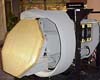
A team comprised of three leading US aerospace and defense contractors has demonstrated an innovative technological use of active electronically scanned array (AESA) radars for high-bandwidth communications. |
|
|

| The content herein, unless otherwise known to be public domain, are Copyright 1995-2006 - SpaceDaily.AFP and UPI Wire Stories are copyright Agence France-Presse and United Press International. ESA PortalReports are copyright European Space Agency. All NASA sourced material is public domain. Additionalcopyrights may apply in whole or part to other bona fide parties. Advertising does not imply endorsement,agreement or approval of any opinions, statements or information provided by SpaceDaily on any Web page published or hosted by SpaceDaily. Privacy Statement |