|
 |
 |
 |
 |
 |
 |
 |
 |

 |
Polar Expedition To Siberian Lake Will Yield Details Of Past Climate
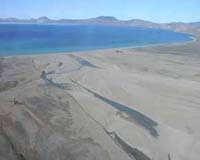
Amherst MA (SPX) Nov 17, 2006 An international team of scientists led by Julie Brigham-Grette of the University of Massachusetts Amherst has received $3.2 million from the National Science Foundation (NSF) to fund an expedition to a polar lake in Siberia, which should yield data that will provide the most detailed record of past Arctic climate to date. The funding, $1.46 million of which goes to UMass Amherst, is the U.S. portion of a nearly $8 million investment by the governments of Germany, Russia, Canada and the International Continental Drilling Program, a collaboration of more than a dozen countries that supports scientific drilling projects investigating the geological and geophysical processes of the Earth's crust. The NSF funding comes from their Earth Sciences Division and the Office of Polar Programs. Understanding the natural climatic variations of the Arctic-such as which aspects are cyclic and which are stable-will illuminate how the region evolved from a warm ecosystem blanketed in forest to a cold one covered in permafrost. And ultimately it could give scientists a glimpse at the Arctic of tomorrow, says Brigham-Grette. "The bottom line is the more we can learn about how the Earth system worked in the past, the more we can be prepared for the future," she says. Colleagues from partner institutions who are also receiving NSF funds are Matt Nolan from the University of Alaska Fairbanks, Jeffrey Snyder of Bowling Green State University and Steve Forman of the University of Illinois at Chicago. The research will occur during the fourth International Polar Year (2007-2008) which aims to provide a better understanding of the world's polar regions through a flurry of international coordination and cooperation by scientists and governments. Laurie Brown, Steve Burns, Robert DeConto and Steve Petsch, all from the department of geosciences at UMass Amherst, are also collaborating with Brigham-Grette. "This funding supports research that will make a critical contribution to understanding climate change," says George M. Langford, dean of the College of Natural Science and Mathematics. "I am especially pleased that Julie and her colleagues in the geosciences department were chosen to lead this impressive team of international scientists." The research team's destination is Lake El'gygytgyn, a lake of roughly nine miles across that was formed when a meteorite hurtled into northeastern Siberia around 3.6 million years ago. Unlike much of the Arctic, this lake was never covered by glaciers or ice sheets and thus has received a steady accumulation of sediment since the time of impact. Brigham-Grette and her team will collect deep cores of this sediment-cylindrical columns of dense muck that should provide a detailed narrative of the past climate of the Arctic. Sediment cores that the scientists took in 2003 have already provided the oldest continuous terrestrial record of the Arctic-one 16.7 meter core dated to 300,000 years ago. Now the researchers want to go even deeper-through to the bedrock of the lake to extract cores dating back to the impact that created it, more than 3.5 million years ago. But first the scientists must get to the lake, which is no small task. Lake El'gygytgyn or "Lake E" lies nine time zones east of Moscow. There are no roads in to the lake. Pevek, a town on the coast of the East Siberian Sea, has the closest airport and from there the researchers will travel the final 155 miles inland to the lake via rented helicopters. Through the winter of 2007-winter because the permafrost will only be able to support the weight of the equipment during the frozen months-Brigham-Grette will be getting permits, buying materials and arranging for it all to travel to Lake E via sled convoys and cargo planes. In January of 2008, the team will pitch a small camp at the lake, roughly 35 beds that they will call home the next four months. There may be 50 to 60 mile an hour winds, frigid temperatures and only caribou and wolves for neighbors, says Brigham-Grette. But it is well worth it, she says. Once the cores are extracted, the assemblage of pollen grains, algae and bacteria within the sediment will tell the scientists what was living in and around the lake throughout its history. The researchers will also read the cores for changes in geochemistry, the magnetic orientation of the muck's minerals and other parameters that capture what happened to the Arctic's climate since the time of impact. These data will be compared with cores taken by other teams from the north Atlantic and Pacific oceans, as well as tropical oceans, allowing scientists to address climate change questions on a broad scale. "Examining climate change is like reconstructing a puzzle-a 500 piece puzzle, and we have maybe 80 to 90 pieces," says Brigham-Grette. "This work will fill in a lot of gaps in reconstructing why the Arctic is the way it is today and what it may be like in the future." Community Email This Article Comment On This Article Related Links University of Massachusetts Amherst Learn about Climate Science at TerraDaily.com Climate Science News - Modeling, Mitigation Adaptation
 Climate Change Survival Dependent On More Than Latitude
 Washington DC (SPX) Nov 16, 2006
According to a recent study in Ecological Monographs, predicting the impact of climate change on organisms is much more complicated than simply looking at species northern and southern range limits. |
|
|

| The content herein, unless otherwise known to be public domain, are Copyright 1995-2006 - SpaceDaily.AFP and UPI Wire Stories are copyright Agence France-Presse and United Press International. ESA PortalReports are copyright European Space Agency. All NASA sourced material is public domain. Additionalcopyrights may apply in whole or part to other bona fide parties. Advertising does not imply endorsement,agreement or approval of any opinions, statements or information provided by SpaceDaily on any Web page published or hosted by SpaceDaily. Privacy Statement |