|
 |
 |
 |
 |
 |
 |
 |
 |

 |
Pluto Gets A Six Digit Number
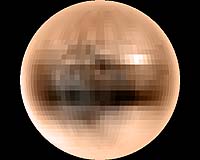
Paris (AFP) Sept 13, 2006 Once the proud outermost planet of the Solar System, Pluto has been consigned to the status of a small-town telephone number after the world's paramount astronomical body tore up its membership of the cosmic A-list. The enigmatic, icy world spotted in 1930 has been given the official monicker of 134340 Pluto and lumped among 136,562 asteroids and other small bodies by the Minor Planet Center (MPC), part of the Paris-headquartered International Astronomical Union (IAU). Pluto's satellites, Charon, Nix and Hydra, have been numbered 134340 I, 134340 II and 134340 III respectively under the latest minor planet list, compiled on September 7. The IAU last month declared Pluto to be a "dwarf planet" that should not belong among the hallowed ranks of Mercury, Earth, Venus, Mars, Jupiter, Saturn, Uranus and Neptune. The organisation is now drawing up a "dwarf planet" catalogue whose initial members will include Pluto, the large asteroid Ceres and a distant object, 2003 UB313, unofficially named Xena. Until the IAU meeting, 2003 UB313 had laid claim to being the Solar System's 10th planet. Rebel astronomers are circulating a petition, contesting the "dwarf planet" definition as unscientific and the decision on Pluto as undemocratic. They intend to hold a conference next year that, in their view, will overhaul the definition of a planet. Pluto's status had long been contested by astronomers who said its tiny size, odd orbit and orbital plane precluded it from joining the other acknowledged planets. By the new IAU yardstick, a planet has "cleared the neighbourhood around its orbit" -- in other words, it is massive enough to wield a gravity that clears rocks and other debris on its orbital path.
Source: Agence France-Presse Community Email This Article Comment On This Article Related Links Lost Among A Million Outer Planets The million outer planets of a star called Sol
 Myriad Planets In Our Solar System And Copernicus Smiled
 Boulder CO (SPX) Sep 11, 2006
A real revolution is afoot in planetary science. The first shot was fired in 1930, with the discovery of Pluto, but almost no one realized its import. The second and third shots came in the late 1970s, with the discovery of distant objects called Chiron and Charon, but again, few recognized what they would portend. |
|
|

| The content herein, unless otherwise known to be public domain, are Copyright 1995-2006 - SpaceDaily.AFP and UPI Wire Stories are copyright Agence France-Presse and United Press International. ESA PortalReports are copyright European Space Agency. All NASA sourced material is public domain. Additionalcopyrights may apply in whole or part to other bona fide parties. Advertising does not imply endorsement,agreement or approval of any opinions, statements or information provided by SpaceDaily on any Web page published or hosted by SpaceDaily. Privacy Statement |