|
 |
 |
 |
 |
 |
 |
 |
 |

 |
Pleas for help as Indonesia defends quake aid
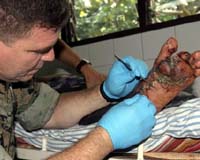
Bantul, Indonesia (AFP) Jun 1, 2006 Indonesia defended the earthquake relief effort as angry survivors pleaded for help and aid agencies said many victims lacked medical care and water four days after the disaster. Supplies from nations around the world began to reach the tens of thousands of people left homeless and hungry by the quake, but problems with distribution continued to dog the massive operation, agencies said as survivors in some areas spent a fifth night without shelter. "The logistical bottlenecks are in the field," Puji Pujiono, deputy area coordinator for United Nations operations in the quake zone, said Wednesday. "Calls for assistance are increasing every day, but they may not be met by the system as fast as one would like." Sukiman, 48, a truck driver hired to deliver relief supplies, said many people were still in need of the basics. "A lot of them are still complaining ... they need some food and tents for the short term," said Sukiman, who lives in hard-hit Bantul district south of the royal city of Yogyakarta. "There are so many victims, I cannot reach them all," he said. In some places, residents were sleeping in the open with only clothing and tents made of rice bags to protect them. "There are a lot of traumatized people and there is not much to eat," said Sutikno, 32. Indonesian officials defended the relief operation as President Susilo Bambang Yudhoyono left after a four-day tour of the quake zone. "The situation is getting better and better, especially in the area of distribution," said Major General Bambang Darmono, the coordinating officer on the ground for the national disaster management agency. "Every area has been reached by the distribution effort," he told AFP. "I know there are a lot of people complaining but it doesn't mean there is no activity." Welfare Minister Aburizal Bakrie said Indonesia would start handing out cash -- 3,000 rupiah (33 cents) to each homeless survivor per day -- rather than food aid, saying it would help bolster the local economy and be more practical. "There are good and bad survivors. Sometimes in one place, the food is all snatched up by a few and some do not get any," he said. The scale of the disaster caused by Saturday's 6.3-magnitude earthquake on Indonesia's main island of Java became clearer as the death toll rose to 5,846, with some 22,000 injured, the social affairs ministry said. Nearly 49,000 homes were destroyed and more than 118,000 others damaged, it said. Hope of finding anyone still alive in the wreckage have been all but abandoned. International humanitarian aid and foreign medical teams were pouring into the disaster zone, with more than a dozen countries sending personnel to the area, while nearly a dozen more have offered cash and supplies. "Healthcare, shelter, water and sanitation are the main issues," UN spokeswoman Amanda Pitt told AFP. "We can't do anything for the dead. So we have to focus on the living and make sure they have these sorts of services." The UN's Pujiono said many survivors needed emergency care, warning of the threat of infection of those with open wounds. "As time passes, and at the end of the first week, all of the wounds are coming to the point of being a problem, so there is the threat of infections," Pujiono told AFP. But he urged Indonesians not to panic about the spread of disease, saying there was no threat of cholera and dysentery. The United States joined the operation, setting up a military field hospital in badly-damaged Sewon south of Yogyakarta. Navy medics quickly treated about 30 patients, and was to be fully operational on Thursday. "People really just started showing up because apparently the word of mouth is out," Navy Commander Tom Davis, who heads the facility, told AFP, saying his staff had treated infected wounds, burns and a baby hit by falling rubble. Indonesian military and rescue helicopters delivered badly-needed food to isolated areas, and transported the injured to hospital. In one village in Klaten district, residents scrambled to scoop up boxes of instant noodles dropped from an air force helicopter, saying it was the first aid they had received. "This is the first time," Yusuf Wayu, 30, shouted over the roar of the still-whirring rotor blades. "The situation here is very serious. Ninety-nine percent of the houses are destroyed and 11 people died." Pitt said clean drinking water was now reaching most areas, thanks to non-governmental organizations such as Oxfam and the UN Children's Fund (UNICEF), but said hospitals still needed more water to disinfect their equipment. As for housing, the UN spokeswoman said residents were in desperate need of plastic sheeting. Rain began to douse the area as night fell Wednesday, which Pujiono warned could also pose sanitation problems for survivors. Community Email This Article Comment On This Article Related Links Bringing Order To A World Of Disasters A world of storm and tempest When the Earth Quakes
 US develops hurricane evacuation plans for pets
 Washington (AFP) May 31, 2006
 Animal welfare advocates on Wednesday said they had worked with the US government to develop new measures to protect pets in the event of another natural disaster like Hurricane Katrina, in which tens of thousands of pets died. |
|
|

| The content herein, unless otherwise known to be public domain, are Copyright 1995-2006 - SpaceDaily.AFP and UPI Wire Stories are copyright Agence France-Presse and United Press International. ESA PortalReports are copyright European Space Agency. All NASA sourced material is public domain. Additionalcopyrights may apply in whole or part to other bona fide parties. Advertising does not imply endorsement,agreement or approval of any opinions, statements or information provided by SpaceDaily on any Web page published or hosted by SpaceDaily. Privacy Statement |