|
 |
 |
 |
 |
 |
 |
 |
 |

 |
Planck Spacecraft Fine Balancing in LSS
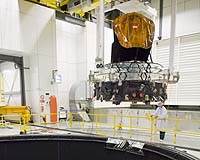
Noordwijk, Netherlands (ESA) Apr 15, 2008 On Wednesday the 2nd of April the Planck flight model spacecraft was placed inside the Large Space Simulator (LSS) at the ESTEC test facilities for fine balancing. After the arrival on 28 March at ESTEC, unpacking, and several spacecraft preparations in the cleanroom, the Planck spacecraft was hoisted up from its ground support equipment (GSE) and transferred to the LSS by means of the overhead crane. After its placement inside the LSS, removal of the telescope's protective cover and inspections of the spacecraft and setup, a dry run was performed on Thursday morning, 3 April. The dry run was performed in ambient conditions with the door of the LSS still open, to verify the stability of the configuration before the actual fine balancing activities. Later that day the LSS was closed and the proper test runs started. Over the following days the Planck spacecraft was repeatedly spun inside the LSS in light-vacuum conditions (1 mbar) at 30 rpm. Four sets of ten test runs were performed between 3 and 9 April, using masses attached to the spacecraft's service module for fine balancing. As Planck is a spin-stabilized spacecraft that will rotate in space at 1 rpm, the fine balancing of the spacecraft is required to ensure that the spacecraft spins around its nominal spin axis, with a minimal wobble that falls within specifications. The first set of ten test runs (spinning both clockwise and counter clockwise to eliminate any systematic errors) was performed with no masses attached to obtain a reference in vacuum of the spacecraft wobble, which was compared with the values expected from a detailed model. In the following sets of measurements 4.5 kg was attached to the service module and the spacecraft was spun again at 30 rpm, with different orientations between the spacecraft and the mounting to eliminate uncertainties in the contribution from the mounting. On Wednesday, 9 April, the last spin test was completed and later that day the LSS was repressurized. With the successful completion of the fine balancing in light-vacuum conditions, the spacecraft is being hoisted out of the LSS today, Friday 11 April. At the end of next week the Planck spacecraft will be prepared for transport from the ESTEC test facilities in Noordwijk to the Centre Spatial de Li�ge (CSL). Community Email This Article Comment On This Article Related Links Space Telescope News and Technology at Skynightly.com
 The Largest Synthesized Telescope In Europe Doubles Its Surface
 Munstereifel-Effelsberg, Germany (SPX) Apr 14, 2008
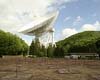
The 100m Radio Telescope Effelsberg enters operations of the e-EVN network, enhancing its sensitivity to detect the radio sky providing the sharpest images in nearby real time. The European radio interferometric network e-EVN almost doubles its sensitivity with the addition of the largest radio telescope in Europe. |
|
|

| The content herein, unless otherwise known to be public domain, are Copyright 1995-2007 - SpaceDaily.AFP and UPI Wire Stories are copyright Agence France-Presse and United Press International. ESA Portal Reports are copyright European Space Agency. All NASA sourced material is public domain. Additional copyrights may apply in whole or part to other bona fide parties. Advertising does not imply endorsement,agreement or approval of any opinions, statements or information provided by SpaceDaily on any Web page published or hosted by SpaceDaily. Privacy Statement |