|
 |
 |
 |
 |
 |
 |
 |
 |

 |
Plan Drawn Up To Meet Recommendations Of Enquiry Into Flight 142
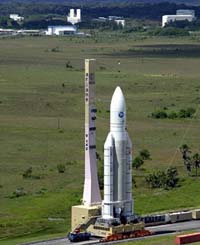
Paris - August 7, 2001 The independent Inquiry Board, set up by Arianespace to examine the reason why the recent Flight 142 did not successfully complete its mission, has now submitted its findings. Arianespace reports today that the board has pinpointed the causes for the anomaly and recommended corrective measures. All of the recommendations have been accepted and will be applied as quickly as possible. The Inquiry Board's report The Inquiry Board made a complete analysis of all measurements recorded during Flight 142 and studied the production, quality and technical background documents concerning all Ariane 5 missions to date. Also reviewed by the board was the work of production and development teams in Europe. The board's findings confirmed that all processing and countdown operations for Flight 142 proceeded nominally, as did the Ariane 5's flight prior to ignition of the upper stage's Aestus engine. The report identified a combustion instability during the Aestus engine's ignition. The resulting degraded engine combustion conditions led to a lower than normal thrust output. In addition, these conditions also resulted in the premature depletion of one of the propellants, which in turn caused the engine to shut down earlier than normal. The strong pressure variation responsible for the combustion instability upon Aestus engine ignition is attributed to a dynamic hydraulic coupling between the upper stage's propellant feed system and the engine's combustion chamber internal circuits. As part of its investigation, the Inquiry Board clearly ruled out any link between the Ariane 5's upper stage malfunction and the operation of propulsion systems on the Ariane 4 launch vehicle. Recommendations The abnormal operating conditions encountered during Flight 142 will be studied in depth to further define the engine's ignition phase. The following recommendations have been made:
Arianespace accepted all of the recommendations and said that they would be applied as quickly as possible in coordination with the manufacturers concerned. Action plan After analyzing the board's recommendations, Arianespace, together with the European Space Agency and the French CNES space agency, and with the support of the Ariane Programme industrial partners, has defined the following action plan:
Based on the timely application of this action plan, Arianespace now expects the next Ariane 5 launch to take place in late November. This would be a delay of about two months compared with the initial schedule. Arianespace launches continue Arianespace is continuing its launch activities at Europe's spaceport in French Guiana with the next mission, Flight 143, which will use an Ariane 4 to orbit the Intelsat 902 communications satellite. Flight 143 is now scheduled for the end of August.
Email This Article Comment On This Article Related Links Arianespace ESA Launchers About Artemis SpaceDaily Search SpaceDaily Subscribe To SpaceDaily Express The latest information about the Commercial Satellite Industry
 Globalstar Buys Central American Satellite Gateway Operator
 Milpitas CA (SPX) Jan 11, 2006
Globalstar recently announced that it has signed a definitive agreement to acquire 100% of the stock of Globalstar Americas Telecommunications, Globalstar Americas Holdings, and Astral Technologies Investments. |
|
|

|
|
|
|
|
|
|
|
|
|
|
|
| The content herein, unless otherwise known to be public domain, are Copyright 1995-2006 - SpaceDaily.AFP and UPI Wire Stories are copyright Agence France-Presse and United Press International. ESA PortalReports are copyright European Space Agency. All NASA sourced material is public domain. Additionalcopyrights may apply in whole or part to other bona fide parties. Advertising does not imply endorsement,agreement or approval of any opinions, statements or information provided by SpaceDaily on any Web page published or hosted by SpaceDaily. Privacy Statement |