|
 |
 |
 |
 |
 |
 |
 |
 |

 |
Pitt Researchers See Electron Waves In Motion For First Time
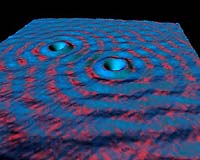
Pittsburgh PA (SPX) Jun 23, 2005 Both the ancient art of stained glass and the cutting-edge field of plasmonics rely on the oscillation of electrons in nanosized metal particles. When light shines on such particles, it excites the electromagnetic fields on the metal's surface, known as "surface plasmons," and causes its electrons to oscillate in waves - producing the rich hues of stained glass. But because electrons move nearly as fast as light, those oscillations have been difficult to observe and had never before been seen in motion. Now, in a paper published in the current issue of the journal Nano Letters, Pitt researchers have demonstrated a microscopy technique that allows the movement of the plasmons to be seen for the first time, at a resolution a trillion times better than conventional techniques. Hrvoje Petek, professor of physics and astronomy at Pitt, and Hong Koo Kim, Pitt professor of electrical and computer engineering, codirectors of Pitt's Institute of NanoScience and Engineering, showed in their paper, "Femtosecond Imaging of Surface Plasmon Dynamics in a Nanostructured Silver Film," that it is indeed possible to achieve high-resolution imaging through a combination of ultra-fast laser and electron optic methods. Although theoretically possible, this technique had never been demonstrated in practice. Petek and Kim used a pair of 10-femtosecond (one quadrillionth of a second) laser pulses to induce the emission of electrons from the sample, a nanostructured thin silver film. Scanning the pulse delay, they recorded a movie of surface plasmon fields at 330 attoseconds (quintillionths of a second) per frame. The video is available online at http://pubs.acs.org. Their research is a boon to the emerging field of plasmonics. Currently, semiconductor chips each contain "about a mile" of wires, said Petek. When electrons carry electrical signals through such wires they collide about every 10 nanometers (10-8 m). In part, this causes problems because the chips give off too much heat. The solution may be to send the signal as plasmon waves, which would lead to faster chips and less dissipation of energy, Petek said. Other researchers on the paper were Atsushi Kubo and Ken Onda, postdoctoral research associates in Pitt's Department of Physics and Astronomy, and Zhijun Sun and Yun S. Jung, doctoral students in Pitt's Department of Electrical and Computer Engineering. All are affiliated with the University's Institute of NanoScience and Engineering. Community Email This Article Comment On This Article Related Links University of Pittsburgh SpaceDaily Search SpaceDaily Subscribe To SpaceDaily Express Understanding Time and Space
 Unified Physics Theory Explains Animals Running Flying And Swimming
 Durham NC (SPX) Jan 05, 2006
A single unifying physics theory can essentially describe how animals of every ilk, from flying insects to fish, get around, researchers at Duke University's Pratt School of Engineering and Pennsylvania State University have found. The team reports that all animals bear the same stamp of physics in their design. |
|
|

| The content herein, unless otherwise known to be public domain, are Copyright 1995-2006 - SpaceDaily.AFP and UPI Wire Stories are copyright Agence France-Presse and United Press International. ESA PortalReports are copyright European Space Agency. All NASA sourced material is public domain. Additionalcopyrights may apply in whole or part to other bona fide parties. Advertising does not imply endorsement,agreement or approval of any opinions, statements or information provided by SpaceDaily on any Web page published or hosted by SpaceDaily. Privacy Statement |