
 |
 |
 |
 |
 |
 |
 |
 |
 |

 |
Pioneering conservancies struggle to save Kenya's wildlife jewel
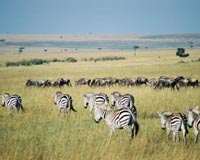
Maasai Mara, Kenya (AFP) Aug 27, 2008 Investors and conservationists have dreamt up an innovative business plan to save Kenya's iconic Maasai Mara, a wildlife haven threatened by over-grazing, farming and mass tourism. Around August each year, swarms of wildebeests come stampeding from neighbouring Tanzania's Serengeti plains to find pasture in the Maasai Mara, in a great migration recently dubbed the world's "eighth wonder". "Twelve years ago, there were 1.2 million wildebeests, last year we had only 300,000. If nothing is done, it could put pay to the migration forever," says Ron Beaton, a leading Kenyan conservationist. Having lived in the Maasai Mara for the past 34 years, farming wheat before launching a high-end lodge, Ron Beaton knows better than most the dangers looming over the crown jewel of Kenya's tourism industry. "We could be looking at a repetition of the bison and buffalo disappearance in North America," he warns. Beaton was one of the masterminds of an idea that germed two years ago and is aimed at making conservation a viable alternative for the Maasais, the main custodians of the country's wildlife treasure. The Maasai Mara national park is a protected area, but the ecosystem around it -- which is four times larger -- is privately owned. In 2000, the Kenyan authorities started subdividing the land into small plots for Maasai families. In a pastoralist culture where land had always been considered as God-given, the newly-acquired notion of ownership soon led to tensions between neighbours trespassing to find pasture for their livestock. Cramped for grazing in their shrivelled estates, many Maasais opted for wheat farming or simply sold their plots to developers. Both outcomes contributed to choking the natural habitat of the lions and elephants so prized by the world's tourists. "The Maasai had to make a choice because the pastoralist lifestyle was no longer sustainable," says Dickson Kaelo, a Maasai academic who was instrumental in promoting a new model of private conservancies that would benefit all. Maasai landowners outside the boundaries of the national park were not getting returns from game viewing fees and could see little reason not to spear or poison their cattle's predators. In 2006, dozens of Maasai landowners in the immediate surroundings of the Mara reserve and private tourism investors teamed up to create the Olare Orok conservancy. "The new arrangement is that having wildlife earns you money, whether there are tourists or not," says Kaelo. Using a completely new approach to generating and sharing tourism revenue, Olare Orok hosts four luxury tourist lodges to form a conservancy of more than 20,000 acres bordering the national reserve. The conservancy brings together the 150-acre plots of some 150 Maasai landowners, who lease the land to the tourism partners in exchange for a fixed rent providing better income than what they could achieve with farming. Upon signing the five-year lease, landowners move out their huts and allow wildlife to roam freely in the conservancy, which is run by a management company itself operating under a foundation. The Hasla-Mara foundation follows a unique mix of a commercial and philanthropic models to make the conservancy viable, in stark departure from the model prevailing in the national park where income generated by viewing fees was poorly redistributed to the community by a corrupt council. "Wheat and maize you can grow anywhere in the world but these people don't have the efficiency per acre that others have and when prices drop they'll be the first to lose out," Hasla-Mara founder A.J. Patel explains. Patel, a wealthy businessman of Indian origin who grew up in Uganda before his community was expelled by Idi Amin in 1972 and now lives in California, says the Maasais were never encouraged to see wildlife as their main wealth. "In any business, the more exotic a product the higher price it commands... With this wildlife, they have one of the best exotic products in the world," he says, the sun setting behind him as he returns from a game drive. "Maasai Mara is a brand just like Coca-Cola, there's no reason it can't generate its own income." If replicated, the model could create large protected corridors in Africa, Patel says, citing Doug Tompkins, the former founder of the Esprit clothing company who turned environmentalist to create reserves in Chile and Argentina. Mismanaged reserves and ecosystems don't just lead to a loss of wildlife, and many have warned that Maasai tribesmen could suffer the same unravelling of their social fabric as the American Indian community in the United States. Conservationists argue that Kenya's new conservancy model can also help the Maasais -- prone to social woes such as drinking when thrust into an urban environment -- preserve their identity by reclaiming their original lifestyle. "We used to take predators as our enemies but Maasais are natural conservationists," says Daniel Sopia, a young landowner from the neighbouring Motorogi conservancy, where British tycoon Richard Branson has plans for a luxury ecolodge. "But now we see animals as very precious, they are a life support to many." This seemingly flawless new model recently hit a snag however, when Kenya's environment authority slapped a ban on development to curb the kind of mass tourism which was turning the Maasai Mara reserve into a giant car park. "It has caught us at a critical stage," says Beaton. "This directive was very much needed for the Mara... but it should have been targeted only at the protected area because a blanket freeze is going to put into question the development of responsible conservancies." "If the ban is effected, even within three years years, we will have nothing left to save," says Dickson Kaelo. Community Email This Article Comment On This Article Share This Article With Planet Earth
Related Links Africa News - Resources, Health, Food
 West Africa's coastline redrawn by climate change: experts
 Accra (AFP) Aug 22, 2008
Rising sea levels caused by climate change will brutally redraw a 4,000-kilometre (2500-mile) stretch of west African coastline from Senegal to Cameroon by century's end, experts were told AFP Friday. |
|
|

| The content herein, unless otherwise known to be public domain, are Copyright 1995-2007 - SpaceDaily.AFP and UPI Wire Stories are copyright Agence France-Presse and United Press International. ESA Portal Reports are copyright European Space Agency. All NASA sourced material is public domain. Additional copyrights may apply in whole or part to other bona fide parties. Advertising does not imply endorsement,agreement or approval of any opinions, statements or information provided by SpaceDaily on any Web page published or hosted by SpaceDaily. Privacy Statement |
 del.icio.us
 Digg
Digg Reddit
 YahooMyWeb
 Google
 Facebook