|
 |
 |
 |
 |
 |
 |
 |
 |

 |
Physicists Transmit Visible Light Through Miniature Cable
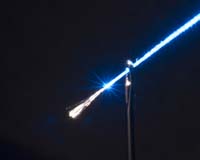
Chestnut Hill MA (SPX) Jan 09, 2007 Physicists at Boston College have beamed visible light through a cable hundreds of times smaller than a human hair, an achievement they anticipate will lead to advances in solar power and optical computing. The discovery, details of which appear in the Jan. 8 issue of the journal Applied Physics Letters, defies a key principle that holds that light cannot pass through a hole much smaller than its wavelength. In fact, the BC team forced visible light, which has a wavelength of between 380-750 nanometers, to travel down a cable whose diameter is smaller than even the low end of that range. The researchers say their achievement opens the door to a wide array of new technologies, from high-efficiency, inexpensive solar cells to microscopic light-based switching devices for use in optical computing. The technology could even be used to help some blind people see, the physicists say. The advance builds upon the researchers' earlier invention of a microscopic antenna that captures visible light in much the same way radio antennae capture radio waves - a discovery they announced in 2004. This time, the BC physicists designed and fabricated a tiny version of the coaxial cable - the Information Age workhorse that carries telephone and Internet service along with hundreds of television and radio channels into millions of homes and businesses around the world. "Our coax works just like the one in your house, except now for visible light," says Jakub Rybczynski, a research scientist in the Boston College Physics Department and the lead author of the APL article. Coaxial cables are typically made up of a core wire surrounded by a layer of insulation, which in turn is surrounded by another metal sheath. This structure encloses energy and lets the cable transmit electromagnetic signals with wavelengths much larger than the diameter of the cable itself. With this design in mind, the physicists developed what they called a "nanocoax" - a carbon nanotube-based coaxial cable with a diameter of about 300 nanometers. By comparison, the human hair is several hundred times wider. The physicists designed their nanocoax so that the center wire protruded at one end, forming a light antenna. The other end was blunt, allowing the scientists to measure the light received by the antenna and transmitted through the medium. The researchers were able to transmit both red and green light into the nanocoax and out the other end, indicating that the cable can carry a broad spectrum of visible light. "The beauty of our nanocoax is that it lets us squeeze visible light through very small geometric dimensions. It also allows us to transmit light over a distance that is at least 10 times its wavelength," says BC Physics Prof. Kris Kempa, a co-author of the article. Other co-authors include BC Physics professors Michael Naughton, Andrzej Herczynski, and Zhifeng Ren, as well as graduate student Yang Wang of BC, Zhongping Huang and Dong Cai of NanoLab Inc. in Newton, Mass., and Michael Giersig of the Center for Advanced European Studies and Research in Bonn, Germany. Community Email This Article Comment On This Article Related Links Boston College Advanced Medical Science For Earth and Beyond Understanding Time and Space
 SIM PlanetQuest To Predict Date Of Cosmic Collision
 Pasadena CA (JPL) Jan 08, 2007
Scientists plan to pin down the date of a galactic collision billions of years in our future by first reaching back to the Big Bang, a feat that will be made possible by the extreme precision of NASA's planned SIM PlanetQuest mission. By recreating some of the earliest moments of our portion of the universe, a team led by the University of Maryland's Ed Shaya will establish for the first time the masses and orbits of galaxies ranging from one million to 15 million light years from Earth. |
|
|

| The content herein, unless otherwise known to be public domain, are Copyright 1995-2006 - SpaceDaily.AFP and UPI Wire Stories are copyright Agence France-Presse and United Press International. ESA PortalReports are copyright European Space Agency. All NASA sourced material is public domain. Additionalcopyrights may apply in whole or part to other bona fide parties. Advertising does not imply endorsement,agreement or approval of any opinions, statements or information provided by SpaceDaily on any Web page published or hosted by SpaceDaily. Privacy Statement |