|
 |
 |
 |
 |
 |
 |
 |
 |

 |
Photosynthetic Trends In Northern Circumpolar High Latitudes
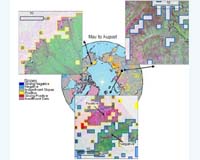
Falmouth MA (SPX) May 18, 2006 Using time series analyses of a 22-year record of satellite observations across the northern circumpolar high latitudes, scientists at the Woods Hole Research Center are assessing trends in vegetation photosynthetic activity. The results indicate that tundra areas consistently and predominantly show greening trends while forested areas show browning, indicating that the boreal forest biome might be responding to climate change in previously unexpected ways. This research is highlighted in the current issue of Earth Interactions. According to Andrew Bunn, lead author of the paper and a post-doctoral fellow at the Center, "This research suggests that the high latitudes might not be responding to climate change as previously thought. If the ability of boreal forests to capture and store carbon in a warmer world is not as great as we've previously supposed, then we will have to think differently about how the planet will respond to continuing emissions of carbon dioxide." All land surfaces above 50� N, excluding the glaciers of Greenland, were included in this study. Growing seasons were defined as May to August though early and late growing season periods were also considered. Three primary data sets derived from polar-orbiting satellites were used. Overall, tundra areas show marked greening over the entire growing season. These patterns were consistent with relatively simple climate response seen in related work in North America, where areas responded to summer maximum temperatures while the response of forest vegetation was more complex. Boreal forests patterns indicate significant greening in May and June, with gains offset by substantive browning in July and August. These results illustrate a need for an expanded observational network, additional analysis of existing data sets, including tree rings, and improvements in process models of ecosystem responses to climate change. According to Scott Goetz, a senior scientist at the Center and co-author of the paper, "This work extends our previous analyses by specifically considering issues of vegetation type and density over this vast region, as well as differences in seasonality of photosynthetic gains and losses. Rather than a systematic greening of high latitudes with warmer temperature, we are seeing a more nuanced and surprisingly rapid response to changes in climate. "What we'd like to know is whether these trends will continue to result in forest decline, exacerbating the impact of warming, or will the forests somehow be able to adapt? Models can tell us what is likely to occur, but we are most anxious to see what the satellite observations will reveal over the next few years." Dr. Bunn is an ecologist interested in understanding climate change impacts on the biosphere. He is particularly interested in understanding the natural range of climate variability over the last two thousand years using natural archives of past temperature and precipitation derived from tree rings. He was awarded a Canon National Parks Science Scholarship in 2001 for work combining tree rings, remote sensing, and computer simulations of high elevation forests in Sequoia National Park. He earned a master's degree from Duke University and a doctorate from Montana State University. Dr. Goetz works on the application of satellite imagery to analyses of environmental change, including monitoring and modeling links between land use change, forest productivity, biodiversity, climate, and human health. Before joining the Center, he was on the faculty at the University of Maryland for seven years, where he maintains an adjunct associate professor appointment, and was a research scientist at NASA's Goddard Space Flight Center. He received his Ph.D. from the University of Maryland. Community Email This Article Comment On This Article Related Links Woods Hole Research Center Climate Science News - Modeling, Mitigation Adaptation
 The Risks Of Living In Low-Lying Coastal Areas
 Tuvalu Islands, South Pacific Ocean (SPX) May 18, 2006
For many, sea-level rise is a remote and distant threat faced by people like the residents of the Tuvalu Islands in the South Pacific, where the highest point of land is only 5 meters (15 feet) above sea level and tidal floods occasionally cover their crops in seawater. |
|
|

| The content herein, unless otherwise known to be public domain, are Copyright 1995-2006 - SpaceDaily.AFP and UPI Wire Stories are copyright Agence France-Presse and United Press International. ESA PortalReports are copyright European Space Agency. All NASA sourced material is public domain. Additionalcopyrights may apply in whole or part to other bona fide parties. Advertising does not imply endorsement,agreement or approval of any opinions, statements or information provided by SpaceDaily on any Web page published or hosted by SpaceDaily. Privacy Statement |