|
 |
 |
 |
 |
 |
 |
 |
 |

 |
Photo Opportunities At 18,000 MPH
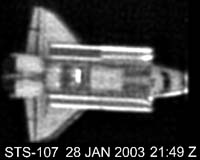
Sacramento - Feb 27, 2003 As for the possibility that photography of Columbia in orbit by the Air Force's powerful satellite surveillance cameras might have revealed the damage, the Feb. 17 NY Times says: "NASA managers could have enlisted powerful Air Force telescopes in Hawaii and New Mexico. The option was discussed and rejected as pointless. "In 1998, NASA had used the Hawaii telescope to inspect Sen. John Glenn's shuttle, which had lost a drag parachute door on liftoff. 'We reviewed the pictures, and they did not reveal a lot of granularity that would help us,' Mr. Dittemore said... "But today both facilities have far more powerful telescopes than they had in 1998. Under good atmospheric conditions, those telescopes could have zeroed in on individual tiles, managers from both facilities said in interviews." And, indeed, a series of photos were taken of Columbia from the Maui telescope and have now been released. They show quite good resolution -- very possibly good enough to reveal signs of tile damage on the Shuttle's underside -- but every one of them was taken of its upper surface and payload bay! According to the Feb. 26 "Space.com", a request to take photos of the Shuttle's underside was made, "but it came informally between shuttle and military managers at Kennedy Space Center and Patrick Air Force Base in Florida. Before any such pictures were taken by the military, the formal process set up for such requests put a stop to it because NASA officials by then had concluded that the images wouldn't show anything, and the [Boeing] damage assessment was such that there were no concerns. "The E-mails [newly released on Feb. 26] were, in effect, an apology from NASA to the Air Force and an assurance that in the future such requests would only be made, and should only be requested, through the formal process set up between the two governmental agencies." To quote the Feb. 17 Times article again: "It is not clear if NASA's mission managers were aware of the stronger telescopes, but they have acknowledged that their decision making was influenced by a second assumption: "Even if I had information, I can't do anything about it,' Mr. Dittemore told reporters the day after the accident." Such a combination of simple confidence that nothing serious had probably happened -- combined with fatalism (the awareness, as Dittemore says, that if serious damage had occurred nothing could be done to save the astronauts anyway) -- may indeed have been the motivator for NASA's apparent hunker-down attitude over the foam-impact incident throughout the flight. But another factor may have been the belief that, if (as expected) nothing disastrous did happen, the entire affair could be more successfully played down afterwards to the press if relatively little was said at the time about the possibility of trouble. (As Daugherty said in his E-mail, "I imagine this is the last we will hear of this.") Unfortunately, evidence also continues to accumulate that -- while it's now totally impossible for NASA to completely cover up any evidence that neglect led to this new disaster -- it may be trying to at least delay its revelation as long as possible, to reduce its public impact. Most of the recently released documents gradually unveiling the entire sequence of events have not been released voluntarily by NASA, but have been pried loose from it by journalists utilizing the Freedom of Information Act. These include not only most of the E-mails mentioned above, but a newly released document revealing that Boeing actually knew as early as Jan. 24 that not just one but three big pieces of foam had broken loose, with at least two hitting Columbia. "If we did not say three pieces at first, it was completely inadvertent on our part and it was a mistake," said a NASA spokesman -- but the fact remains that NASA had voluntarily released two earlier Boeing post-launch studies concluding that only one piece of foam had come loose. Regardless of whether a post-disaster partial concealment attempt is now underway, the more important question is why the Shuttle team was so lackadaisical in its studies of possible harmful effects from foam impacts BEFORE Columbia's launch. Actual simulations of foam impacts against a copy of the Shuttle's wing within a wind tunnel are now imminent, and in this writer's opinion are the most promising means by which the actual cause of the tragedy can be determined. But why weren't they carried out before the flight, after earlier incidents involving big chunks of foam coming loose? The ability of a computer program like Crater to extrapolate the effects of such big impacts from its stored information on the effects of vastly smaller ones is obviously extremely limited. Nor did NASA adequately study the possibility that the foam might have been infused with ice. In an earlier piece, I noted the possibility that the millions of tiny holes deliberately made in the foam to allow trapped air to vent during ascent might have allowed rainwater to get into the foam. And two engineers have since pointed out to me that, even if liquid water was too viscous to trickle into them, during the hours in which the Shuttle was sitting fueled on the pad the humidity from the air itself entering the punctures might easily have frozen into ice when it contacted the supercold wall of the tank itself, thus gradually filling up the punctures with ice which would have been invisible to the launch pad inspection team. Moreover, several experts interviewed by the New York Times have flatly contradicted NASA's statement that even non-punctured foam was "completely waterproof" -- especially after NASA deliberately trimmed off its tough outer skin to smooth its surface (and reduce the mass of any dry bits of foam hitting the Shuttle, as had happened on STS-87). "In experiments conducted in 1999, scientists at Huntsman Polyurethanes measured how much water polyurethane foam absorbs when exposed to 75 percent relative humidity. Over 30 days, a piece of foam with its outer skin intact increased in weight by 25 percent; a piece without the outer skin tripled in weight." The Times has also interviewed workers at the Michoud Assembly Facility who reported that they and other workers had routinely taken "shortcuts" and made unreported minor repairs to the foam layers they were applying to Shuttle external tanks, to keep up with the company's hurried schedule. The Columbia investigation board is looking into these reports. Former Shuttle astronaut Carl Meade says, "My only question to the team is how complacent did the team become in looking at these things. And if complacency ruled the day, that's atrocious. That's a shame. If you hit a bug going Mach 2, you're going to damage a tile. I don't buy the arguments that say it was not a big deal." But now we come to a bigger point: any neglect NASA engaged in regarding the possible hazards from foam were simply one aspect of the fact that it has not looked in full detail into a whole swarm of potential problems with the Shuttle since flights resumed after the Challenger tragedy. The Washington Post's Feb. 23 article describes in detail the variety of other serious problems experienced with Columbia even during its post-Challenger flights -- of which the booster joint problem on STS-35 was only one: "[B]etween 1996 and 1999 the orbiter had at least five 'escapes' -- a NASA term for a mission that flew with a problem that only 'luck or providence' prevented from causing serious damage. On another launch, a worker made what NASA calls a 'diving catch', meaning his diligence caught a flaw routine checks had missed." Two such problems came, separately, within a hair of forcing a trans-Atlantic abort on Columbia's July 1999 flight to deliver the Chandra X-ray telescope to orbit. There was widespread speculation among observers even before the Columbia tragedy -- including statements of concern by both houses of Congress last year in their official appropriations bills -- that NASA was falling seriously short of spending what it needed to properly maintain Shuttle safety, in order to continue feeding the ever-growing fiscal maw of the International Space Station. That speculation is growing even faster now. Astronaut Robert (Hoot) Gibson also notes that he had expressed concerns as far back as 1989 regarding the now-confirmed fact that Columbia's left wing had a slightly rougher aerodynamic surface than the other wings on the Shuttles, and that this had repeatedly caused it to switch from smooth "laminar" airflow over the wing to "turbulent" airflow (which heats the wing much more seriously) much earlier during reentrys than is normal. But he says that his concerns were "ignored and disregarded." It is possible that relatively minor damage done to the wing by the falling foam, or some other cause, may have combined with this slightly greater natural roughness to produce an accident that otherwise would not have occurred.
Community Email This Article Comment On This Article Related Links SpaceDaily Search SpaceDaily Subscribe To SpaceDaily Express Space Analysis and Space OpEds
 The Cold Equations Of Spaceflight
 Honolulu HI (SPX) Sep 09, 2005
In the past month, we have been blessed with numerous leaks from NASA of various study documents relating to the new boosters that will be needed to carry out the new manned moon program. I've been monitoring the large volume of Web chatter about these plans, and have noticed a disturbing theme therein.
--------------------------------------------------------- It's new. And it's downright terrific! Celestron's CPC Schmidt-Cassegrain telescope is the scope you've been waiting for! It offers new alignment technology, advanced engineering, and bold new design at a new, low price! In fact, Celestron's Professional Computerized (CPC) scope with revolutionary SkyAlign Alignment Technology redefines everything that amateur astronomers are looking for. It offers quick and simple alignment, GPS technology, unsurpassed optical quality, ease of use, advanced ergonomics, enhanced computerization and, most important, affordability. Want to view M-31 tonight? One button takes you there!
Shop for telescopes online at Telescopes.com! today!
|
|
|

| The content herein, unless otherwise known to be public domain, are Copyright 1995-2006 - SpaceDaily.AFP and UPI Wire Stories are copyright Agence France-Presse and United Press International. ESA PortalReports are copyright European Space Agency. All NASA sourced material is public domain. Additionalcopyrights may apply in whole or part to other bona fide parties. Advertising does not imply endorsement,agreement or approval of any opinions, statements or information provided by SpaceDaily on any Web page published or hosted by SpaceDaily. Privacy Statement |