
 |
 |
 |
 |
 |
 |
 |
 |
 |

 |
Phoenix Mars Lander Extends Trench
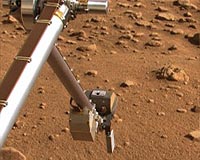
Tucson AZ (SPX) Jul 16, 2008 NASA's Phoenix Mars Lander is using its Robotic Arm to enlarge an exposure of hard subsurface material expected to yield a sample of ice-rich soil for analysis in one of the lander's ovens. The trench was about 20 by 30 centimeters (8 by 12 inches) after work by the arm on Saturday. The team sent commands yesterday to extend the longer dimension by about 15 centimeters (6 inches). Experiments with a near-duplicate of the lander in Tucson during the past week indicate that the bigger surface is needed to allow steps planned for collecting an icy sample from the Martian trench informally named "Snow White." "Right now, there is not enough real estate of dark icy soil in the trench to do a sample acquisition test and later a full-up acquisition" for the Thermal and Evolved-Gas Analyzer, said Ray Arvidson, Phoenix's "dig czar," from Washington University in St. Louis. The arm's rasp will kick the icy soil into the scoop through a special capture mechanism, and scientists also want to scoop up any loose material left in the trench from the rasping activity, Arvidson said. Samples of shallower, non-icy soil from the Snow White trench have already been examined in Phoenix's wet chemistry laboratory and optical microscope, and a fork-like probe has checked how well nearby soil conducts electricity and heat. "The Phoenix science team is working diligently to analyze the results of the tests from these various instruments," said Phoenix principal investigator Peter Smith of The University of Arizona. "The preliminary signatures we are seeing are intriguing. Before we release results, we want to verify that our interpretations are correct by conducting laboratory tests." As the Robotic Arm was extracting the fork-like conductivity probe from the soil on Saturday, the arm contacted a rock called "Alice," near the "Snow White" trenching area. The arm is programmed to stop activity when it encounters an obstacle. The team assessed the arm's status on Sunday and decided to resume use of the arm on Monday. Yesterday's commands called for the Robotic Arm to move away from the rock, dump out soil that is in the scoop and extend the Snow White trench approximately 15 centimeters (6 inches) toward the lander. Community Email This Article Comment On This Article Share This Article With Planet Earth
Related Links Phoenix at LPL Phoenix at JPL Phoenix at NASA Mars News and Information at MarsDaily.com Lunar Dreams and more
 Sample-Collection Tests By Phoenix Lander Continue
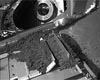 Tucson AZ (SPX) Jul 11, 2008
NASA's Phoenix Mars Lander's science and engineering teams are testing methods to get an icy sample into the Robotic Arm scoop for delivery to the Thermal and Evolved Gas Analyzer, or TEGA. |
|
|

| The content herein, unless otherwise known to be public domain, are Copyright 1995-2007 - SpaceDaily.AFP and UPI Wire Stories are copyright Agence France-Presse and United Press International. ESA Portal Reports are copyright European Space Agency. All NASA sourced material is public domain. Additional copyrights may apply in whole or part to other bona fide parties. Advertising does not imply endorsement,agreement or approval of any opinions, statements or information provided by SpaceDaily on any Web page published or hosted by SpaceDaily. Privacy Statement |
 del.icio.us
 Digg
Digg Reddit
 YahooMyWeb
 Google
 Facebook